- Home
- About
- Rates
- Calculator
- Loan Programs
- Down Payment Assistance
- FHA Loans
- Conventional Loans
- VA Loans
- Jumbo Loan
- DSCR Loans
- Self-Employed Loans
- Second Mortgages
- P&L Loans
- HELOC Loans
- Bank Statement Loans
- Reno/Rehab Loans
- Reverse Mortgages
- USDA Loans
- Construction Loans
- Debt Consolidations Loan
- Investor Loans
- Equity Builder Rapid Payoff Loan
- Doctor Loans
- Teacher Loans
- Law Enforcement Loans
- Resources
- News
Transform Your Home with Renovation & Rehab Loans
Finance your purchase and renovation costs in one streamlined loan. Perfect for fixer-uppers, investment properties, and dream home transformations.
- Purchase
- Refinance
- Cash Out
- Consolidation
- Residence
- Investment
Up to $750K+
Combined Purchase & Renovation Financing
Single Closing
One Loan, One Payment During Construction
FHA 203(k) & More
Multiple Program Options Available
15+ Years
Renovation Loan Expertise
97%
Client Satisfaction Rate
$500M+
Renovation Projects Funded
3,000+
Dream Homes Transformed
Why Choose Renovation Loans?
Renovation loans offer the unique ability to transform a fixer-upper into your dream home or profitable investment with streamlined financing and expert support.
Single Construction Loan
Finance both the purchase price and renovation costs in one convenient loan, eliminating the need for separate construction financing.
No Upfront Cash Needed
Roll your renovation costs into the mortgage—no need to drain your savings or use credit cards for home improvements.
Based on After-Repair Value
Qualify based on your home's future value after renovations, not its current condition, maximizing your borrowing power.
Flexible Timeline
Take up to 12 months to complete your renovations with contractor draws released as work progresses and is inspected.
FHA, Conventional & VA Options
Multiple loan programs available including FHA 203(k), Fannie Mae HomeStyle, and VA Renovation loans with various requirements.
Build Instant Equity
Create immediate equity by purchasing below-market properties and renovating them to full market value or beyond.
Expert Guidance & Support
Work with renovation loan specialists who understand construction timelines, contractor management, and draw procedures.
Investment Property Friendly
Available for investment properties and fix-and-flip projects, not just primary residences, with competitive investor terms.

Renovation Loans vs. Traditional Financing
See how renovation loans simplify the process of buying and improving a property compared to traditional purchase-then-renovate approaches.
RECOMMENDED
Renovation Loans
Streamlined all-in-one financing
- Single loan for purchase + renovation costs
- Based on after-repair value (ARV)
- One closing, one monthly payment
- Contractor draws during construction
- No separate construction loan needed
- Lower overall interest costs
- FHA, Conventional, VA options available
- Build equity immediately
Traditional Approach
Separate purchase & renovation financing
- Must pay cash for renovations upfront
- Based only on current property value
- Multiple loans and payments required
- Use savings or high-interest credit
- Need second mortgage or HELOC
- Higher combined interest rates
- Limited financing options
- Equity builds slowly over time
Ready to transform your property with streamlined financing?
Let our renovation loan experts show you how much you can borrow and save.
How the Renovation Loan Process Works
From finding the perfect fixer-upper to moving into your transformed home, we guide you through every step with expert support.
1
Find Your Property
Locate a fixer-upper or property with renovation potential. Our team can help you evaluate whether a property qualifies for renovation financing.
2
Get Pre-Approved
Complete your loan application and get pre-approved based on the property's after-repair value. We'll review your finances, credit, and renovation plans.
3
Create Renovation Budget
Work with licensed contractors to develop detailed work specifications and cost estimates. Our team reviews and approves your renovation scope.
4
Close & Start Construction
Close on your loan in a single transaction. Renovation funds are held in escrow and released as work is completed and inspected.
5
Complete Renovations
Contractors complete approved work within 12 months. Our team coordinates inspections and draw releases to keep your project on track.
6
Move Into Your Dream Home
Once renovations are complete and final inspection passes, your loan converts to permanent financing with one simple monthly payment.
Timeline: 45-60 Days to Close
Most renovation loans close within 45-60 days. Renovation work must be completed within 12 months, with draws released as work progresses.
Success Stories from Renovation Loan Clients
Real homeowners and investors who transformed properties with streamlined renovation financing.
"I found the perfect fixer-upper but didn't have cash for renovations. The FHA 203(k) loan allowed me to purchase the home and finance a complete kitchen and bathroom remodel in one loan. The team guided me through every step, from contractor selection to final inspection. Now I have my dream home with instant equity!"

Michael Thompson
First-Time Homebuyer & Renovator
"As an investor, renovation loans have been a game-changer for my business. I can acquire distressed properties, finance the rehab costs, and create immediate equity—all with one streamlined loan. The draw process was professional and efficient. I've now completed 8 projects using this financing strategy!"

Sarah Rodriguez
Real Estate Investor
Frequently Asked Questions
Get answers to common questions about renovation loans, the process, and requirements.
You can finance most structural and cosmetic improvements including kitchen and bathroom remodels, room additions, roof replacement, HVAC systems, flooring, windows, siding, landscaping, and more. Luxury items like pools and spas may have restrictions depending on the loan program. All work must be completed by licensed contractors.
Loan amounts vary by program. FHA 203(k) loans go up to standard FHA limits (typically $472,030-$1,089,300 depending on location). Conventional HomeStyle Renovation loans can go up to $726,200 for conforming loans or higher for jumbo renovation loans. Your loan amount is based on the lesser of the purchase price plus renovation costs, or the after-repair value (ARV).
FHA 203(k) loans require only 3.5% down and accept lower credit scores (typically 580+), but have stricter property standards and contractor requirements. Conventional HomeStyle Renovation loans require 5-20% down with higher credit scores (usually 620+), but offer more flexibility on property types and renovation scope. VA Renovation loans are also available for eligible veterans.
Renovation funds are held in an escrow account. As work is completed, your contractor submits a draw request with documentation. Our team or a third-party inspector verifies the work is complete and meets standards, then releases funds directly to the contractor. Most loans allow 3-6 draws depending on project size and timeline.
Yes! Conventional HomeStyle Renovation loans are available for investment properties with 15-25% down depending on the number of properties you own. FHA 203(k) loans are only for primary residences. We also offer specialized fix-and-flip financing for real estate investors with different terms and requirements.
Most renovation loans allow up to 12 months to complete all approved work. Some limited 203(k) loans for minor repairs may have shorter timelines (6 months). Extensions are sometimes possible with lender approval if unexpected issues arise. It's important to work with reliable contractors who can meet your timeline.
Minimum credit score requirements vary by program: FHA 203(k) typically requires 580-620, Conventional HomeStyle Renovation usually requires 620-680, and VA Renovation loans may go as low as 580. Higher scores get better rates. We can help borrowers with challenged credit explore their options and improve their scores if needed.
It depends on the scope of work. For extensive renovations affecting major systems (electrical, plumbing, HVAC) or structural work, you may need to move out temporarily for safety. For cosmetic improvements or room-by-room projects, you can often remain in the home. FHA 203(k) requires the property to be habitable within 30 days of closing.


Ready to Transform Your Property?
Whether you're buying a fixer-upper as a first-time homebuyer or a seasoned investor acquiring your next project, our renovation loan experts will show you how to maximize your financing potential with streamlined construction-to-permanent loans.
Call Us Today
(916) 232 3040
Email Us
[email protected]
Single Loan
Purchase + Renovation in One
Up to 12 Months
To Complete Your Project
Expert Support
From Application to Move-In
Renovation & Rehab Loans
- Purchase
- Refinance
- Cash Out
- Consolidation
- Residence
- Investment
You can use Renovation & Rehab Mortgage Loans for the financing purposes of PURCHASE, REFINANCE, CASH-OUT, DEBT-CONSOLIDATION, RENOVATION, REHAB, REMODEL, GROUND UP CONSTRUCTION for both your primary residence and for rental investment property.
Transform Homes with After-Improved Value Financing
Finance both the purchase and renovation of a property with a single loan that's based on the final, after-improved value.
Key Features:
Single-close solution
After-repairs & upgrades included
FHA & conventional options
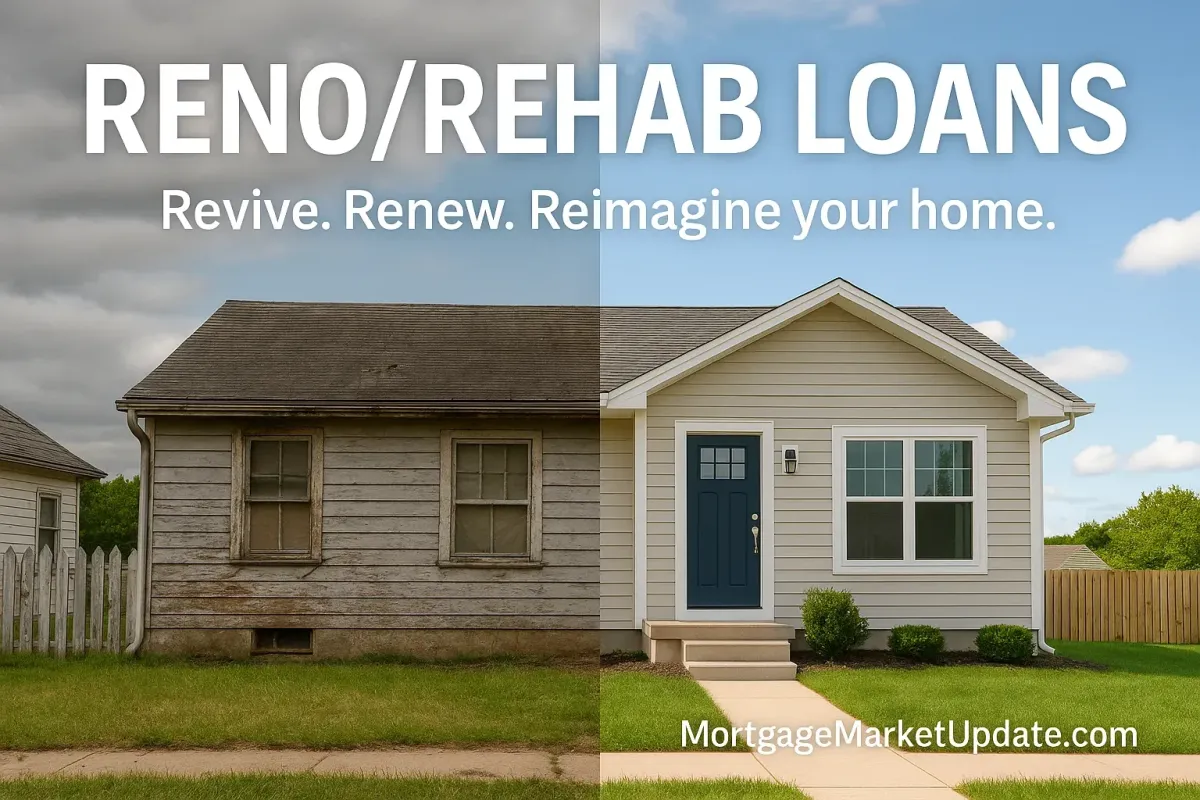
Renovation Loan Benefits

One Loan, Two Purposes
Combine loan for purchase and renovation into one, with one set of fees and one monthly payment.

After-Improved Value
Loan amount is based on the after-improved value, not just the purchase price, so you can maximize your renovation budget.

Expand Your Options
Fixer-uppers, older homes, and even luxury homes can qualify for renovation loans, giving you more flexibility in your home search or refinance.

Multiple Renovation Types
Options for cosmetic improvements, full gut rehabs, energy efficiency upgrades, or luxury renovations. Some programs allow second homes or investment.

Professional Oversight
Lender-approved contractors and inspections help keep your project on track and compliant with lending guidelines.

Various Program Options
Choose from conventional, FHA, VA, and USDA renovation loans to find the best fit. Some options allow do-it-yourself work for certain projects.
Documentation You'll Need
The list of documentation items shown below is a good general list. However, based on your borrower profile overlayed with the specific loan program underwriting guidelines, you may need to provide additional information. In some circumstances, you may not need to provide the entire list of items. Speak with Rodney Rose, your trusted loan officer, for your specific documentation needed.
Tax returns - You will need to fill in a Form 4506-T, and provide your tax forms (the last 2 years should suffice).
Pay stubs, W-2s, 1099's, K-1's, or other proof of income -These include your most recent 1 month of pay stubs. If you are self-employed you must provide the two most recent tax returns as well as a year-to-date profit and loss statement. If you file a separate business tax return, you will need to provide the most recent 2 years along with a year-to-date profit and loss statement.
Bank statements and other assets - Lenders need your most recent 2 months bank statements and may request proof of your retirement accounts, assets, as well as other investment accounts.
Credit history and FICO score - Your credit report will be obtained which will provide details of your credit payment history, including any episodes of bankruptcies or foreclosures.
Gift letters - If any friend or family member wants to help you with the down payment or closing costs by offering you some cash you must provide a “gift letter” which states that the money is a gift and not a loan.
Photo ID - Provide a government issued ID with photo such as a driver's license or passport.
Renting history - Your history as a tenant on rent to guarantee you can pay your rent bills on time.
Co-Borrower or Co-Signor - If a Co-Borrower or Co-Signor is used in qualifying. You will need to provide all of the same items for them also.
Ready to Transform Your Property?
Let's discuss how a renovation loan can help you create the home of your dreams.
Renovation Loan Process

Pre-Approval
Determine your budget for purchase and renovations. We’ll help you understand different renovation loan programs and maximum loan amounts.

Property Selection
Find a property that needs improvements and meets program requirements. Some programs allow for limited repairs, while others permit full rehabs or additions.

Renovation Planning
Work with your contractor to outline plans, obtain estimates, and submit renovation plans for lender review and approval.

Appraisal & Approval
An appraisal will determine the as-completed value based on your renovation plans. The lender will review your complete application for approval.

Loan Closing
Once approved, you’ll close on your renovation loan. Initial funds are disbursed at closing; renovation funds are held in escrow and disbursed as work is completed.

Renovation Phase
Renovation begins with periodic inspections and draw disbursements as work progresses. Interest is typically only charged on funds that have been disbursed.
Renovation Loan Options
Credit Score
Minimum 3.5% down payment
Contractor-only, no DIY work
Major structural work allowed
More paperwork/oversight
Up to 6 months of mortgage payments can be included
FHA 203(k) Limited
Streamlined process
No structural repairs allowed
Maximum $35,000 in repairs
Quicker closing
Ideal for cosmetic improvements
Fannie Mae Home Style
Minimum 5% down payment
Wider renovation scope (even luxury)
More flexible renovation options
Lower mortgage insurance costs
Can be used for investment properties
Renovation Loan Eligibility
Credit Score
Minimum requirement varies by program; generally 620+ for conventional, 580+ for FHA.
Lower rates may require 680-740+.
Credit Score
FHA renovation loans require 3.5% down; conventional options may allow as low as 3% down.
Some programs permit gift funds for down payment.
Debt-to-Income Ratio
Maximum DTI ratios typically range from 36–45%, with lenders focusing on your ability to handle potential cost overruns.
Property Types
Most programs allow single-family homes, some condos, select 2-4 units, and PUDs.
Some options apply for second homes or investment.
Renovation Scope
Eligible improvements include repairs, additions, energy upgrades, and even luxury amenities; the scope is limited depending on the program.
Payment History
Licensed, insured contractors vetted and approved by the lender.
DIY work may be allowed on certain programs for qualified borrowers.
Frequently Asked Questions
What types of renovation loans are available?
Common renovation loan programs include FHA 203(k) Standard and Limited, Fannie Mae HomeStyle, VA renovation loans, and USDA renovation loans. Each has different requirements, loan limits, and eligible renovation scopes.
How much can I borrow with a renovation loan?
Loan amounts are typically based on the lower of the purchase price plus renovation costs or a percentage of the appraised after-completion value (typically up to 97% for FHA or 95% for conventionals). Maximum loan amounts vary by program and location.
What renovations can I finance with these loans?
Eligible renovations include repairs, additions, energy upgrades, kitchens, bathrooms, and more. Luxury items like swimming pools may be restricted in some programs.
How are renovation funds disbursed?
Funds are disbursed in draws (typically 5-7) at predetermined stages of construction after inspection confirms the work has been completed. Interest is only charged on the amount disbursed, not the total loan amount.
Can I do some of the work myself?
Most renovation loan programs require licensed contractors for all work. However, FHA 203(k) may allow owner-builders or sweat equity for minor repairs, while Fannie Mae HomeStyle options typically permit only Professional contractors or specialty approval.
How long do I have to complete the renovations?
Most programs require renovations to be completed within 6 months after closing, though extensions may be granted for larger projects. Work must begin within a specified timeframe after closing, typically within 30 days.

E Mortgage Capital, Inc. is a full-service mortgage company that offers extensive options for residential mortgages, with quick service and leading rates
Loan
Information
About
Legal
Rodney Rose
NMLS#: 1396861
DRE#: 00853403
E Mortgage Capital, Inc.
NMLS#: 1396861
DRE#: 00853403
Locations
915 Highland Pointe Dr, Roseville, CA 95678, USA
3401 Mallory Ln, Franklin, TN 37067, USA
3750 S Susan Street Santa Ana, CA 92704