










Hands stacking coins to illustrate saving, budgeting, or building financial growth

Mortgage Rate Intelligence & Market Updates

Stay informed about economic developments that may influence mortgage rates and home financing decisions. Explore updates covering inflation, Federal Reserve policy, Treasury yields, housing trends, and other important market indicators. Use the category filters to browse relevant economic and mortgage news, then select an article to read the full update. Review the latest stories and market insights to better understand changing conditions when considering your mortgage options.
RATE WATCH
FED FUNDS RATE 3.88%
NEXT FOMC 10/28/2026
NEXT MOVE 28.4% HIKE
IMPLIED CHANGE +7.1 bps
12-MONTH OUTLOOK +83.0 bps 3-4 HIKES
TARGET BAND 3.75 - 4.00%
SOFR 3.89%
LATEST FED UPDATE 10/6/2026

What Today’s Economic Data Can Mean for Mortgage Rates

Mortgage rates can respond to changes in inflation, employment, Federal Reserve policy, Treasury yields, and expectations about future economic growth. These factors do not determine mortgage rates by themselves, but they can influence the broader bond market and the pricing lenders offer.

For homebuyers and homeowners, the important question is not simply whether economic news is “good” or “bad.” The key is how new information changes expectations for inflation, interest rates, and the economy. Those changes can contribute to mortgage rate movement and affect purchasing power, refinance opportunities, and monthly payment estimates.

Use the market updates below as supporting information, then consider your specific loan type, credit profile, property, and financing goals when evaluating current mortgage options.

Economic News Hub

Real Estate & Financial Market Updates

Article
Assessing the Current State of Wage Inflation

Assessing the Current State of Wage Inflation

Martin Almuzara, Richard Audoly, and Davide Melcangi Economists often look at nominal wage growth to gauge labor market imbalances, price pressures, and households’ spending ability. But to use wage growth…
AI’s Macroeconomic Challenges and Promises

AI’s Macroeconomic Challenges and Promises

Simone Lenzu In the third quarter of 2025, America’s largest tech firms for the first time spent more on capital investment than they earned from operations. The implication is that…
The Global Credit Cycle in Corporate Bond Returns

The Global Credit Cycle in Corporate Bond Returns

Nina Boyarchenko and Leonardo Elias The global corporate nonfinancial bond market is both a large investment asset class and a vital source of funding for nonfinancial firms. With $19 trillion…
Honey, Who Shrunk the U.S. Income Surplus?

Honey, Who Shrunk the U.S. Income Surplus?

Matthew Higgins and Thomas Klitgaard Foreign holdings of U.S. financial assets are immense, with official estimates putting their current market value at $69 trillion. U.S. holdings of foreign assets are also…
Do Job Postings Show Early Labor‑Market Effects of AI?

Do Job Postings Show Early Labor‑Market Effects of AI?

Richard Audoly, Miles Guerin, and Giorgio Topa As generative AI tools become more widely used, a key issue is the technology’s impact on labor demand. Where might we find evidence…
Federal Student Loan Defaults Return After Pandemic Pause

Federal Student Loan Defaults Return After Pandemic Pause

Zara Jacob, Donghoon Lee, Daniel Mangrum, Joelle W. Scally, and Wilbert van der Klaauw During 2026:Q1, household debt balances increased slightly, by $18 billion, to reach $18.8 trillion, according to…
Will Mounting Supply Chain Strains Hamstring the AI Investment Boom?

Will Mounting Supply Chain Strains Hamstring the AI Investment Boom?

Hunter L. Clark, Jeffrey B. Dawson, and Shad Turney Editor’s Note: The original version of the post included an inaccurate statement about the last chart. The chart itself is correct….
Stress and Strain from NBFIs to Banks

Stress and Strain from NBFIs to Banks

Viral V. Acharya, Nicola Cetorelli, and Bruce Tuckman Do the recent stresses in the NBFI space—notably the bankruptcies of Tricolor and First Brands, and the decision of Blue Owl Capital…
Rodney Rose Mortgage Team
Loans available nationwide
Low Rate, Low Fee.
"A Loan for every home"
Guaranteed Closing*
Rodney Rose, Loan Officer and Branch Manager
Rodney Rose
Loan Officer / Branch Manager
NMLS#: 1396861 DRE#: 00853403
C: (916) 232 3040
E: rrose@emortgagecapital.com
W: MortgageMarketUpdate.com
Better Business Bureau accreditation badge on a white background
Offices
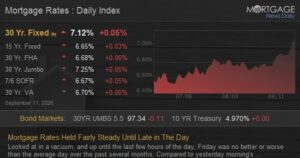
Mortgage rates daily index showing 30-year fixed rate at 7.12%

Mortgage Rates Held Fairly Steady Until Late in The Day

Looked at in a vacuum, and up until the last few hours of the day, Friday was no better or worse than the average day over the past several months. Compared to yesterday morning’s levels, the average lender was 0.01% higher–a small enough move to be effectively considered “unchanged.”  This expanded to 0.05% in the last few hours as multiple lenders increased rates. In terms of big-picture benchmarks, the increase officially brings rates to their highest levels since early 2025. To be clear, we were just barely lower than May 2025 levels yesterday. Now we’re in line February 2025 levels. The intraday market movement was interesting. The bond market (which underlies mortgage rate movement) actually improved this morning even though Fed rate hike expectations increased following a slightly hotter inflation reading in this morning’s economic data. This is an uncommon pattern. There are two ways to look at it. First, longer-term rates may have been encouraged by the uptick in Fed rate hike expectations because that provided reassurance that Fed was more likely to take steps to combat higher inflation. In other words, some of the upward pressure in longer-term rates is thought to have been driven by fear of Fed inaction. If this morning’s inflation data was hot enough to increase the odds of action, but not so hot as to cause a material change in the inflation outlook, it’s the perfectly warm bowl of porridge. In OTHER other words, yes! There’s a scenario where longer-term rates (things like mortgages and 5-10yr Treasury yields) actually WANT the shortest-term rates (like the Fed Funds Rate) to move higher.


Read More »
Existing Home Sales Dip Below 4 Million as Inventory Builds

Existing Home Sales Dip Below 4 Million as Inventory Builds

Existing-home sales slipped in August, falling below the 4 million annualized pace for the first time since June 2025, while a sharp increase in inventory gave buyers more options and pushed the supply of homes to its highest level in more than a decade. The National Association of REALTORS® reported a 2.0% decline in sales from July to a seasonally adjusted annual rate of 3.98 million , while sales were 1.2% lower than a year earlier. “Mortgage rates and home sales move in opposite directions, so it’s not surprising to see a mild dip in home buying activity due to high mortgage rates,” said NAR Chief Economist Lawrence Yun. He noted that sales are still 1.6% higher year-to-date through the first eight months of the year, with wage growth and job creation helping to support demand despite elevated borrowing costs. Inventory provided a more encouraging development for buyers. Total housing inventory rose to 1.62 million units , up 3.2% from July and 5.9% from a year ago. It was the first time since November 2019 that inventory exceeded 1.6 million units. The increase in supply pushed the market to a 4.9-month supply , up from 4.6 months in both July and August 2025. Yun noted that the current level is the highest in more than ten years and should give buyers more room to negotiate. Despite higher inventory, home prices continued to climb, although the pace of appreciation remained modest. The median existing-home price increased to $429,100 , up 1.6% from August 2025 and marking the 38th consecutive month of year-over-year price increases.

Read More »
Refinance demand declining before recent mortgage rate spike with application form and house keys

Refi Demand Declining Even Before Most Recent Rate Spike

Mortgage application activity pulled back last week, with a sharp decline in refinancing more than offsetting relatively stable purchase demand as mortgage rates moved higher. The Mortgage Bankers Association (MBA) reported a 2.7% decrease in total application volume on a seasonally adjusted basis for the week ending September 4. Purchase applications were little changed, slipping just 0.2% from the previous week on a seasonally adjusted basis. On an unadjusted basis, purchase activity fell 3%, but remained 4% higher than the same week one year ago, earning it’s spot as the one positive note for this week’s report. Refinancing was a different story. The Refinance Index fell 6% from the previous week and was 25% below year-ago levels, reaching its slowest weekly pace since May 2025. Refinances also accounted for a smaller portion of overall mortgage activity, with the refinance share falling to 40.9% from 41.8% the previous week. Notably, this data was collected before this week’s sharpest rate spikes, so this trend will likely accelerate next week. “Mortgage rates moved higher last week, driven by ongoing investor concerns over inflation and the federal budget deficit,” said Joel Kan, MBA’s Vice President and Deputy Chief Economist. Kan noted that the 30-year fixed rate reached 6.85%, its highest level since June 2025 and 36 basis points above the same time last year.

Read More »
Mortgage industry update on AI tools, compliance, prepayments, inflation, and higher rates

AI Warehouse, Compliance Education Tools; Rocket’s Limits; Who is Prepaying; Inflation = Higher Rates

Most of us 30 years old and older have tales about where they were and what they did 25 years ago. Being in capital markets, and selling MBS, for over 40 years, I knew people who died in New York that day. That said, as an industry, we’re very good at looking forward to, and planning for, the future. Minority home ownership is something every major lender is witnessing. For example, on Monday, September 14, NAHREP and the Hispanic Wealth Project will unveil the 2026 State of Hispanic Wealth Report on Latino economic progress. More than 1.2 million Hispanic households have reached millionaire status, with total Hispanic household wealth more than tripling since 2014. Hispanic households drove all net U.S. homeownership growth in 2025, reaching a record 10.2 million owner-households; real estate remains the largest pillar of Hispanic wealth at 45.5 percent. “For the first time, the report devotes a full section to the risks federal policy changes from the current Administration pose to this progress.” (Today’s podcast can be found here. This week’s ‘casts are sponsored by NFTYDoor, the MLO’s favorite HELOC platform. A broad buy box and hands-on mortgage expertise mean more loans close, faster, for banks, credit unions, and brokers. Clean files close in as little as zero days. Today’s has an interview with Agile’s Greg Vacura on connecting mortgage lenders and broker-dealers to make MBS trading faster, more efficient, transparent, and less reliant on phone-based processes.)

Read More »
By using our site, you agree to use our cookies. For more information, read our Privacy Policy