Hands stacking coins to illustrate saving, budgeting, or building financial growth

Mortgage Rate Intelligence & Market Updates

Stay informed about economic developments that may influence mortgage rates and home financing decisions. Explore updates covering inflation, Federal Reserve policy, Treasury yields, housing trends, and other important market indicators. Use the category filters to browse relevant economic and mortgage news, then select an article to read the full update. Review the latest stories and market insights to better understand changing conditions when considering your mortgage options.
RATE WATCH
FED FUNDS RATE 3.88%
NEXT FOMC 10/28/2026
NEXT MOVE 28.4% HIKE
IMPLIED CHANGE +7.1 bps
12-MONTH OUTLOOK +83.0 bps 3-4 HIKES
TARGET BAND 3.75 - 4.00%
SOFR 3.89%
LATEST FED UPDATE 10/6/2026

What Today’s Economic Data Can Mean for Mortgage Rates

Mortgage rates can respond to changes in inflation, employment, Federal Reserve policy, Treasury yields, and expectations about future economic growth. These factors do not determine mortgage rates by themselves, but they can influence the broader bond market and the pricing lenders offer.

For homebuyers and homeowners, the important question is not simply whether economic news is “good” or “bad.” The key is how new information changes expectations for inflation, interest rates, and the economy. Those changes can contribute to mortgage rate movement and affect purchasing power, refinance opportunities, and monthly payment estimates.

Use the market updates below as supporting information, then consider your specific loan type, credit profile, property, and financing goals when evaluating current mortgage options.

Economic News Hub

Real Estate & Financial Market Updates

Article
Firms’ Inflation Expectations Return to 2024 Levels

Firms’ Inflation Expectations Return to 2024 Levels

Jaison R. Abel, Richard Deitz, and Nick Montalbano Businesses experienced substantial cost pressures in 2025 as the cost of insurance and utilities rose sharply, while an increase in tariffs contributed…
Are Rising Employee Health Insurance Costs Dampening Wage Growth?

Are Rising Employee Health Insurance Costs Dampening Wage Growth?

Jaison R. Abel, Richard Deitz, and Nick Montalbano Employer-sponsored health insurance represents a substantial component of total compensation paid by firms to many workers in the United States. Such costs…
What’s Driving Rising Business Costs?

What’s Driving Rising Business Costs?

Jaison R. Abel, Richard Deitz, and Nick Montalbano After a period of moderating cost increases, businesses faced mounting cost pressures in 2025. While tariffs played a role in driving up…
The Post‑Pandemic Global R*

The Post‑Pandemic Global R*

Marco Del Negro, Elena Elbarmi, and Michael Pham In this post we provide a measure of “global” r* using data on short- and long-term yields and inflation for several countries…
Estimating the Term Structure of Corporate Bond Risk Premia

Estimating the Term Structure of Corporate Bond Risk Premia

Tomas Jankauskas Understanding how short- and long-term assets are priced is one of the fundamental questions in finance. The term structure of risk premia allows us to perform net present…
What Workplace Composition Are Job Candidates Looking For?

What Workplace Composition Are Job Candidates Looking For?

Rachel Schuh Why do workers still segregate by sex across occupations, industries, and firms? Recent research has focused on how preferences for job amenities, like flexibility, may differ by sex….
Seeing Through the Shutdown’s Missing Inflation Data

Seeing Through the Shutdown’s Missing Inflation Data

Martin Almuzara and Geert Mesters Data releases for inflation have been scarce over the past four months due to the government shutdown. As a result, until January 22 no personal…
Who Is Paying for the 2025 U.S. Tariffs?

Who Is Paying for the 2025 U.S. Tariffs?

Mary Amiti, Chris Flanagan, Sebastian Heise, and David E. Weinstein Over the course of 2025, the average tariff rate on U.S. imports increased from 2.6 to 13 percent. In this…
Rodney Rose Mortgage Team
Loans available nationwide
Low Rate, Low Fee.
"A Loan for every home"
Guaranteed Closing*
Rodney Rose, Loan Officer and Branch Manager
Rodney Rose
Loan Officer / Branch Manager
NMLS#: 1396861 DRE#: 00853403
C: (916) 232 3040
E: rrose@emortgagecapital.com
W: MortgageMarketUpdate.com
Better Business Bureau accreditation badge on a white background
Offices
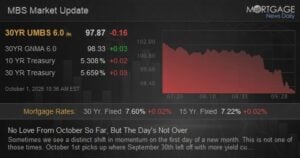
No Love From October So Far, But The Day's Not Over

No Love From October So Far, But The Day’s Not Over

Sometimes we see a distinct shift in momentum on the first day of a new month. This is not one of those times. October 1st picks up where September 30th left off with more yield curve steepening (2yr and 10yr yield getting farther apart). This is a reflection of the sudden shift in economic data expectations last Wednesday combined with the fact that the Fed rate hike outlook has been broadly flat after Wednesday’s pop. It’s still anyone’s game as far as today goes. 10s and MBS are moderately weaker while the 2yr is almost 5bps lower (anchored to those now-resilient Fed Funds Futures). Stronger ISM components (orders, backlogs, prices) caused an initial pop in yields, but we’ve already recovered 20 minutes later.

Read More »
Navigating Geoeconomic Risk in the U.S. Stock Market

Navigating Geoeconomic Risk in the U.S. Stock Market

Geoeconomic risk—the risk that firms incur valuation losses when countries deploy economic, trade, or financial leverage for geopolitical aims—has become a first-order concern for investors. In this post, based on our recent Staff Report, we document that domestic U.S. stocks expose investors to substantial geoeconomic risk through firms’ global supply-chain relationships, affecting investors’ returns and portfolio allocation. We also find that investors are compensated for bearing geoeconomic risk through higher risk premia.

Read More »
Bond market news graphic showing Treasury yields, laptop market chart, and U.S. Capitol backdrop

Just Another Bad Day For Bonds Without New Justification

Just Another Bad Day For Bonds Without New Justification

10yr yields hit another long-term high today, breaking above 5.30% briefly before settling just under 5.29%. There was a flash of hope after the 8:30am econ data, but that reversed fairly quickly. Reasons can be debated. Some would say today’s broadly stronger econ data supported it while pointing out that the “beat” in PCE wasn’t really news in light of the methodology changes. On that note, some might say methodology that drops core PCE by 0.361 (July vs July unrounded) means that Fed policy will be less aggressive in fighting inflation than it otherwise would have been. In that context, today’s heavy underperformance in the long end of the curve actually makes good sense, but it’s just an interesting theory to entertain. Month/Quarter-end compulsory trading could certainly be an ingredient, but there’s no great way to confirm that until several days in the future. Either way, inbound econ data certainly matters on Thu/Fri and the radar perpetually awaits any big blips shaped like Iran war truces (or escalations).

Econ Data / Events

ADP jobs (Sep)

90K vs 70K f’cast, 38K prev

Core PCE (m/m) (Aug)

0.2% vs 0.3% f’cast, 0.2% prev

Core PCE (y/y) (Aug)

3.0% vs 3.3% f’cast, 3.3% prev

Core PCE Prices QoQQ2

3.30% vs 3.6% f’cast, 4.4% prev

Corporate profitsQ2

7.7% vs 8.2% f’cast, 0.5% prev

GDPQ2

2.2% vs 1.5% f’cast, 2.1% prev

GDP Final SalesQ2

2.8% vs 2.2% f’cast, 1.9% prev

PCE (y/y) (Aug)

3.4% vs 3.7% f’cast, 3.7% prev

PCE prices (m/m) (Aug)

0.3% vs 0.4% f’cast, 0.2% prev

Market Movement Recap

10:36 AM MBS down 2 ticks (.06) on the day and a quarter point from highs. 10yr up 2.4bps at 5.269

02:19 PM MBS down a quarter point and 10yr up 5.4bps at 5.299

Read More »
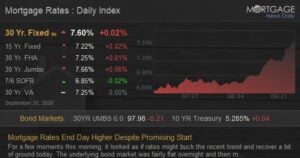
Mortgage Rates End Day Higher Despite Promising Start

Mortgage Rates End Day Higher Despite Promising Start

For a few moments this morning, it looked as if rates might buck the recent trend and recover a bit of ground today. The underlying bond market was fairly flat overnight and then managed to improve after this morning’s PCE inflation data. But that improvement was short-lived.  Top tier 30yr fixed rates jumped to 7.60%. That’s only 0.02% higher than yesterday, but yet another long-term high. As frustrating as it continues to be, there are no convenient scapegoats for the reversal in terms of intraday news/data. Some small case could be made that the day’s economic data wasn’t exactly rate-friendly, but the timing of the market movement and indicators elsewhere in the market suggest that’s a waste of time. The only irrefutable way to connect cause and effect is to use broad strokes. The bond market is in the midst of a fairly rapid reassessment of the outlooks for Fed policy, inflation, and the supply/demand equation for government debt. Today may have seen some additional volatility due to the mechanics of the month/quarter-end trading environment, but not to the extent that anyone should expect rates to magically fall just because tomorrow is a new month.  A meaningful drop in rates will require one or more of these things:
Iran war ending and fuel prices dropping
economic data weakening
inflation falling significantly and sustainably
There are other things that can help/hurt, but these are the big three at the moment. [thirtyyearmortgagerates]

Read More »
By using our site, you agree to use our cookies. For more information, read our Privacy Policy