








Hands stacking coins to illustrate saving, budgeting, or building financial growth

Mortgage Rate Intelligence & Market Updates

Stay informed about economic developments that may influence mortgage rates and home financing decisions. Explore updates covering inflation, Federal Reserve policy, Treasury yields, housing trends, and other important market indicators. Use the category filters to browse relevant economic and mortgage news, then select an article to read the full update. Review the latest stories and market insights to better understand changing conditions when considering your mortgage options.
RATE WATCH
FED FUNDS RATE 3.88%
NEXT FOMC 10/28/2026
NEXT MOVE 28.8% HIKE
IMPLIED CHANGE +7.2 bps
12-MONTH OUTLOOK +78.7 bps 3-4 HIKES
TARGET BAND 3.75 - 4.00%
SOFR 3.88%
LATEST FED UPDATE 10/6/2026

What Today’s Economic Data Can Mean for Mortgage Rates

Mortgage rates can respond to changes in inflation, employment, Federal Reserve policy, Treasury yields, and expectations about future economic growth. These factors do not determine mortgage rates by themselves, but they can influence the broader bond market and the pricing lenders offer.

For homebuyers and homeowners, the important question is not simply whether economic news is “good” or “bad.” The key is how new information changes expectations for inflation, interest rates, and the economy. Those changes can contribute to mortgage rate movement and affect purchasing power, refinance opportunities, and monthly payment estimates.

Use the market updates below as supporting information, then consider your specific loan type, credit profile, property, and financing goals when evaluating current mortgage options.

Economic News Hub

Real Estate & Financial Market Updates

Article
Consumption Sensitivity of Uncertain Households

Consumption Sensitivity of Uncertain Households

Gizem Kosar and Davide Melcangi Uncertainty is a key component of everyday economic decisions of consumers and, perhaps not surprisingly, it plays a central role in economic models. According to…
End‑of‑Month Activity Across the Treasury Market

End‑of‑Month Activity Across the Treasury Market

Michael J. Fleming, Jonathan Palash-Mizner, and Or Shachar In a 2024 post, we showed that interdealer trading in benchmark U.S. Treasury notes and bonds concentrates on the last trading day…
The Rise of Sponsored Service for Clearing Repo

The Rise of Sponsored Service for Clearing Repo

Adam Copeland and R. Jay Kahn Recently instituted rule amendments have initiated a large migration of dealer-to-client Treasury repurchase trades to central clearing. To date, the main avenue used to…
Dutch Treat: The Netherlands’ Exorbitant Privilege in the Eighteenth Century

Dutch Treat: The Netherlands’ Exorbitant Privilege in the Eighteenth Century

Stein Berre and Asani Sarkar The term “exorbitant privilege” emerged in the 1960s to describe the advantages derived by the U.S. economy from the dollar’s status as the de facto…
A Country‑Specific View of Tariffs

A Country‑Specific View of Tariffs

Matthew Higgins and Thomas Klitgaard U.S. trade policy remains in flux. Nevertheless, important elements of the new policy regime are apparent in data through July. What stands out are the…
Do Employers Comply with Pay Transparency Requirements in Job Postings?

Do Employers Comply with Pay Transparency Requirements in Job Postings?

Richard Audoly and Roshie Xing Over the past few months, New Jersey and Vermont have joined a growing number of U.S. states in requiring employers to include an estimated salary…
A Historical Perspective on Stablecoins

A Historical Perspective on Stablecoins

Stephan Luck Digital currencies have grown rapidly in recent years. In July 2025, Congress passed the “Guiding and Establishing National Innovation for U.S. Stablecoins Act” (GENIUS) Act, establishing the first…
Calming the Panic: Investor Risk Perceptions and the Fed’s Emergency Lending During the 2023 Bank Run

Calming the Panic: Investor Risk Perceptions and the Fed’s Emergency Lending During the 2023 Bank Run

Natalia Fischl-Lanzoni, Martin Hiti, and Asani Sarkar In a companion post, we showed that during the bank run of spring 2023 investors were seemingly not concerned about bank risk broadly…
Rodney Rose Mortgage Team
Loans available nationwide
Low Rate, Low Fee.
"A Loan for every home"
Guaranteed Closing*
Rodney Rose, Loan Officer and Branch Manager
Rodney Rose
Loan Officer / Branch Manager
NMLS#: 1396861 DRE#: 00853403
C: (916) 232 3040
E: rrose@emortgagecapital.com
W: MortgageMarketUpdate.com
Better Business Bureau accreditation badge on a white background
Offices

Weaker Start. No New Reasons

Another week begins with the frustrating reality of the bond market selling just because there’s no reason to buy. To be fair, 2yr yields are unchanged, but longer-dated yields are several bps higher than Friday afternoon. All this despite oil prices being lower and econ data being in line with expectations. At this point, anyone offering rationale for the movement is forced to craft a narrative that fits that movement. In other words, if yields were plummeting, the average bond analyst wouldn’t be harping on a laundry list of reasons that bonds are making the incorrect move.


Read More »
Insured, but Still on the Hook: Who Bears the Most Risk in Homeowner’s Insurance?

Insured, but Still on the Hook: Who Bears the Most Risk in Homeowner’s Insurance?

In an April post, using millions of homeowners’ insurance contracts matched with property-level exposure and disaster risk, we showed that although households are insured, they are still “on the hook” because deductibles and coverage limits leave homeowners responsible for part of a loss. Because insurers cannot perfectly observe how well homeowners maintain or protect their properties (a problem known as “moral hazard”), contract terms such as deductibles can play an important role in balancing risk sharing and incentives. By requiring homeowners to bear part of a loss, insurers can preserve incentives for policyholders to take actions that reduce damage risk. In this post, we quantify the cost of keeping homeowners on the hook. How costly is moral hazard in homeowner’s insurance? How much risk must households retain to preserve these incentives? And, importantly, who ultimately bears that residual risk? The short answer is that keeping homeowners on the hook costs insurers relatively little, but it leaves households with substantial risk, especially those least able to absorb a large loss.

Read More »
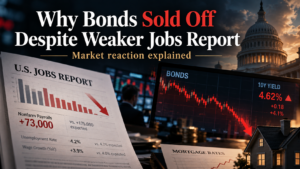
Weaker jobs report beside falling bond chart and rising Treasury yields

Why Bonds Sold Off Despite Weaker Jobs Report

Why Bonds Sold Off Despite Weaker Jobs Report

First off, read the AM commentary if you haven’t already. This recap doesn’t add much to that (but the video adds a lot). Bottom line, NFP was weaker, but that was the worst of the news. The unrounded unemployment rate barely budged and it would have moved LOWER (under 4.00%) were it not for the uptick in labor force participation. Higher oil prices contributed a bit to intraday weakness as did a recovery in French credit spreads. At the end of the day, this wasn’t the jobs report that sowed any seeds of doubt about cracks showing in the labor market.

Econ Data / Events

Average earnings mm (Sep)

0.1% vs 0.3% f’cast, 0.3% prev

Non Farm Payrolls (Sep)

29K vs 90K f’cast, 162K prev

Participation Rate (Sep)

61.8% vs — f’cast, 61.6% prev

Unemployment rate mm (Sep)

4.2% vs 4.1% f’cast, 4.1% prev

Market Movement Recap

10:06 AM Initially much stronger after NFP, but dialing back a bit. MBS up a quarter point and 10yr down 4.1bps at 4.198

02:31 PM MBS now down a quarter point and 10yr up 4bps at 5.28. Cooler heads prevail on jobs report reaction and EU credit spreads

Read More »
By using our site, you agree to use our cookies. For more information, read our Privacy Policy