










Hands stacking coins to illustrate saving, budgeting, or building financial growth

Mortgage Rate Intelligence & Market Updates

Stay informed about economic developments that may influence mortgage rates and home financing decisions. Explore updates covering inflation, Federal Reserve policy, Treasury yields, housing trends, and other important market indicators. Use the category filters to browse relevant economic and mortgage news, then select an article to read the full update. Review the latest stories and market insights to better understand changing conditions when considering your mortgage options.
RATE WATCH
FED FUNDS RATE 3.88%
NEXT FOMC 10/28/2026
NEXT MOVE 29.6% HIKE
IMPLIED CHANGE +7.4 bps
12-MONTH OUTLOOK +77.7 bps 3-4 HIKES
TARGET BAND 3.75 - 4.00%
SOFR 3.88%
LATEST FED UPDATE 10/9/2026

What Today’s Economic Data Can Mean for Mortgage Rates

Mortgage rates can respond to changes in inflation, employment, Federal Reserve policy, Treasury yields, and expectations about future economic growth. These factors do not determine mortgage rates by themselves, but they can influence the broader bond market and the pricing lenders offer.

For homebuyers and homeowners, the important question is not simply whether economic news is “good” or “bad.” The key is how new information changes expectations for inflation, interest rates, and the economy. Those changes can contribute to mortgage rate movement and affect purchasing power, refinance opportunities, and monthly payment estimates.

Use the market updates below as supporting information, then consider your specific loan type, credit profile, property, and financing goals when evaluating current mortgage options.

Economic News Hub

Real Estate & Financial Market Updates

Article
Is Monetary Policy Still Seasonal? 

Is Monetary Policy Still Seasonal? 

Richard Crump, Keshav Dogra, and Dennis Kongoli A 2012 Liberty Street Economics post noted that U.S. monetary policy exhibits a surprising degree of seasonal behavior: over the 1987-2008 period, the…
Banks Develop a Nonbank Footprint to Better Manage Liquidity Needs

Banks Develop a Nonbank Footprint to Better Manage Liquidity Needs

Nicola Cetorelli and Saketh Prazad In a previous post, we documented how, over the past five decades, the typical U.S. bank has evolved from an entity mainly focused on deposit…
U.S. Banks Have Developed a Significant Nonbank Footprint

U.S. Banks Have Developed a Significant Nonbank Footprint

Nicola Cetorelli and Saketh Prazad  In light of the rapid growth of nonbank financial institutions (NBFIs), many have argued that bank-led financial intermediation is on the decline, based on the…
How Has Treasury Market Liquidity Fared in 2025?

How Has Treasury Market Liquidity Fared in 2025?

Michael J. Fleming In 2025, the Federal Reserve has cut interest rates, trade policy has shifted abruptly, and economic policy uncertainty has increased. How have these developments affected the functioning…
Economic Capital: A Better Measure of Bank Failure?

Economic Capital: A Better Measure of Bank Failure?

Beverly Hirtle and Matthew C. Plosser Bank failures and distress can be costly to the economy, causing losses to creditors and reducing the flow of credit and other financial intermediation…
Banking System Vulnerability: 2025 Update

Banking System Vulnerability: 2025 Update

Matteo Crosignani, Thomas Eisenbach, and Fulvia Fringuellotti As in previous years, we provide in this post an update on the vulnerability of the U.S. banking system based on four analytical…
The Shadow Value of Central Bank Lending

The Shadow Value of Central Bank Lending

Tomas Jankauskas, Ugo Albertazzi, Lorenzo Burlon, and Nicola Pavanini After the Great Financial Crisis, the European Central Bank (ECB) extended its monetary policy toolbox to include the use of long-term…
A Danger to Self and Others: Consequences of Involuntary Hospitalization

A Danger to Self and Others: Consequences of Involuntary Hospitalization

Natalia Emanuel, Pim Welle, and Valentin Bolotnyy Every state in the country has a law permitting involuntary hospitalization if a person presents a danger to themselves or others as a…
Rodney Rose Mortgage Team
Loans available nationwide
Low Rate, Low Fee.
"A Loan for every home"
Guaranteed Closing*
Rodney Rose, Loan Officer and Branch Manager
Rodney Rose
Loan Officer / Branch Manager
NMLS#: 1396861 DRE#: 00853403
C: (916) 232 3040
E: rrose@emortgagecapital.com
W: MortgageMarketUpdate.com
Better Business Bureau accreditation badge on a white background
Offices
Will Mounting Supply Chain Strains Hamstring the AI Investment Boom?

Will Mounting Supply Chain Strains Hamstring the AI Investment Boom?

The conflict in the Middle East has precipitated a global supply shock—the third in six years following the pandemic in 2020 and Russia’s invasion of Ukraine in 2022. The current shock raises the specter of spillovers to the U.S. through both prices and physical shortages of goods. A critical conduit for spillovers through these channels is via Asian supply chains, especially from middle- to lower-middle income countries in southeast Asia, which are key suppliers for goods needed for the AI infrastructure build-out in the U.S. These countries are also heavily reliant on Middle East energy imports. This post examines key factors related to these Asian supply chain vulnerabilities.


Read More »
Stress and Strain from NBFIs to Banks

Stress and Strain from NBFIs to Banks

Do the recent stresses in the NBFI space—notably the bankruptcies of Tricolor and First Brands, and the decision of Blue Owl Capital Corp II (OBDC II) to end its redemption program and return capital through a wind-down of the fund—create distress for banks? The general sentiment is that the recent stresses are unlikely to amount to systemic concerns, although it does not mean there might not be “some stress and strain” for banks and that policymakers are “watching carefully” for exposure across banks. In a series of previous posts, we showed that shocks to nonbank financial institutions (NBFIs) directly impact banks that have exposures to NBFIs. In this post, we show that bank stocks have been directly impacted by NBFIs yet again. In short, NBFI troubles do result in “stress and strain” for banks.

Read More »
Same Shock, Different Roads? A K‑Shaped Pattern at the Pump

Same Shock, Different Roads? A K‑Shaped Pattern at the Pump

In March 2026, energy prices surged to a four-year high, driven by the Iranian closure of the Strait of Hormuz amid the ongoing conflict in the Middle East. In this Liberty Street Economics post, we use the new consumer spending module of the Economic Heterogeneity Indicators to analyze recent changes in nominal and real gas consumption across different income groups. We find that households had very different experiences with gasoline spending: in March, high-income households increased nominal spending the most and kept real consumption essentially unchanged, while low-income households decreased real consumption of gasoline but still saw sharply increased nominal spending because of the rise in gas prices. Therefore, with the sharp increases in gasoline prices in March, a K-shaped pattern in gasoline consumption emerged—showing faster consumption growth for high-income households relative to low-income households. These gasoline consumption patterns qualitatively match those following the increase in energy prices at the beginning of the Russia-Ukraine war in spring 2022, even though the gap in consumption trends during the current episode is quantitatively larger.

Read More »
In What Ways Has U.S. Trade with China Changed?

In What Ways Has U.S. Trade with China Changed?

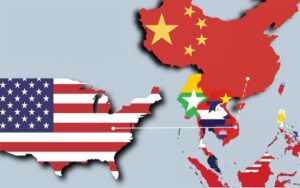
Over the past year, U.S. trade policy with China has undergone enormous changes, but with surprisingly little effect on overall trade balances. In fact, the U.S.’s twelve-month trade deficit, while highly volatile due to import front-running early in the year, ended 2025 at $1.2 trillion, almost unchanged from 2024. At the same time, China’s trade surplus with the world actually increased from $1 trillion to $1.2 trillion. However, when looking at changes between individual countries, one sees large shifts in bilateral balances. In this post, we will focus on changing trade flows between the U.S., China, and southeast Asia.

Read More »
Explaining the K‑Shaped Economy: What’s Behind the Divide?

Explaining the K‑Shaped Economy: What’s Behind the Divide?

In our companion post, we used a new module of our Economic Heterogeneity Indicators (EHIs) to shed light on how recent retail spending growth has been driven by high-income households. This fact is consistent with the popular press’s idea of a “K-shaped economy” in which higher-income households experience faster growth in spending than lower-income households. In this post, we dive deeper into the reasons behind this divergence by analyzing for which goods this trend holds true and ask whether it can be explained by changes in wages, inflation, or wealth. We find that, since 2023, wealth has increased the most for high-income households, while inflation has risen the most for low-income households, with both factors helping explain the fact that real retail spending rose the most for high-income households. In contrast, earnings display a more mixed pattern, though earnings of the highest earners have grown more rapidly than earnings of the lowest earners.

Read More »
Tracking the K‑Shaped Economy: Who’s Driving Spending?

Tracking the K‑Shaped Economy: Who’s Driving Spending?

Aggregate real consumer spending has risen solidly since 2023. However, it is less clear how widely shared this improvement has been across all segments of society. This is important because systematic heterogeneity may mask the dependence of aggregate growth on a relatively small group of households and thus conceal macroeconomic risks. In this post, we use consumer spending data recently added to the Economic Heterogeneity Indicators (EHIs) and find that retail spending growth has been driven by high-income households—those earning more than $125,000 per year. In the popular press, the phenomenon of higher-income households growing at a faster rate than lower-income households has been referred to as the K-shaped economy. We find that consumption has exhibited a K-shaped economy since 2023, although not in the pre-COVID period or during the post-COVID recovery.

Read More »
Bank Failures: The Roles of Solvency and Liquidity

Bank Failures: The Roles of Solvency and Liquidity

Do banks fail because of runs or because they become insolvent? Answering this question is central to understanding financial crises and designing effective financial stability policies. Long-run historical evidence reveals that the root cause of bank failures is usually insolvency. The importance of bank runs is somewhat overstated. Runs matter, but in most cases they trigger or accelerate failure at already weak banks, rather than cause otherwise sound banks to fail.

Read More »
The R*–Labor Share Nexus

The R*–Labor Share Nexus

Over the past quarter century, the U.S. economy has experienced significant declines in both the labor share of income and the natural rate of interest, referred to as R*. Existing research has largely analyzed these two developments in isolation. In this post, we provide a simple model that captures the joint evolution of the labor share and R*, which we call the R*–labor share nexus. Our key finding is that structural changes affecting R* also influence the evolution of the labor share, and thereby wages and prices. This highlights a potentially important channel, absent from many macroeconomic models, through which the factors that determine R* also affect the labor share and, in turn, broader macroeconomic developments, with implications for monetary policy.

Read More »
Use of Gen AI in the Workplace and the Value of Access to Training

Use of Gen AI in the Workplace and the Value of Access to Training

The rapid spread of generative AI (AI) tools is reshaping the workplace at a remarkable rate. Yet relatively little is known about whether workers have access to these tools, how the tools affect workers’ daily productivity, and how much workers value the training needed to use the tools effectively. In this post, we shed light on these issues by drawing on supplemental questions in the November 2025 Survey of Consumer Expectations (SCE), fielded to a representative sample of the U.S. population. We find that adoption of AI tools at work is heterogeneous, that a sizable share of workers see AI training as important, and that a significant share of employers are nonetheless not yet providing access to AI tools or training on how to use them.

Read More »
By using our site, you agree to use our cookies. For more information, read our Privacy Policy