Hands stacking coins to illustrate saving, budgeting, or building financial growth

Mortgage Rate Intelligence & Market Updates

Stay informed about economic developments that may influence mortgage rates and home financing decisions. Explore updates covering inflation, Federal Reserve policy, Treasury yields, housing trends, and other important market indicators. Use the category filters to browse relevant economic and mortgage news, then select an article to read the full update. Review the latest stories and market insights to better understand changing conditions when considering your mortgage options.
RATE WATCH
FED FUNDS RATE 3.88%
NEXT FOMC 10/28/2026
NEXT MOVE 28.4% HIKE
IMPLIED CHANGE +7.1 bps
12-MONTH OUTLOOK +83.0 bps 3-4 HIKES
TARGET BAND 3.75 - 4.00%
SOFR 3.89%
LATEST FED UPDATE 10/6/2026

What Today’s Economic Data Can Mean for Mortgage Rates

Mortgage rates can respond to changes in inflation, employment, Federal Reserve policy, Treasury yields, and expectations about future economic growth. These factors do not determine mortgage rates by themselves, but they can influence the broader bond market and the pricing lenders offer.

For homebuyers and homeowners, the important question is not simply whether economic news is “good” or “bad.” The key is how new information changes expectations for inflation, interest rates, and the economy. Those changes can contribute to mortgage rate movement and affect purchasing power, refinance opportunities, and monthly payment estimates.

Use the market updates below as supporting information, then consider your specific loan type, credit profile, property, and financing goals when evaluating current mortgage options.

Economic News Hub

Real Estate & Financial Market Updates

Article
What Millions of Homeowner’s Insurance Contracts Reveal About Risk Sharing

What Millions of Homeowner’s Insurance Contracts Reveal About Risk Sharing

Hyeyoon Jung and Jaehoon (Kyle) Jung Housing is the largest component of assets held by households in the United States, totaling $48 trillion in 2025. When natural disasters strike, the…
A Closer Look at Emerging Market Resilience During Recent Shocks

A Closer Look at Emerging Market Resilience During Recent Shocks

Hunter L. Clark, Jeffrey B. Dawson, and Julian Gonzalez-Murphy A succession of shocks to the global economy in recent years has focused attention on the improved economic and financial resilience…
The Fed Has Two Tools to Influence Money Market Conditions 

The Fed Has Two Tools to Influence Money Market Conditions 

Adam Copeland and Owen Engbretson  The Federal Reserve’s 2022-23 tightening cycle involved the use of two monetary policy tools: changes in administrative rates and changes in the size of its…
Treasury Market Liquidity Since April 2025

Treasury Market Liquidity Since April 2025

Henry Dyer and Michael J. Fleming In this post, we examine the evolution of U.S. Treasury market liquidity over the past year, which has witnessed myriad economic and political developments….
Behind the ATM: Exploring the Structure of Bank Holding Companies

Behind the ATM: Exploring the Structure of Bank Holding Companies

Lily Gordon and Lee Seltzer Editor’s note: The fifth and sixteenth paragraphs have been revised for technical accuracy. April 8, 2026, 5:00 p.m. Many modern banking organizations are highly complex….
Sports Betting Is Everywhere, Especially on Credit Reports

Sports Betting Is Everywhere, Especially on Credit Reports

Jacob Goss and Daniel Mangrum Editor’s Note: The chart notes for the first chart have been updated to correct errors in how we labeled the trend line colors. (March 25, 2026) Since…
China’s Electric Trade

China’s Electric Trade

Thomas Klitgaard China has spent considerable government resources to develop advanced electric technology industries, such as those that produce electric vehicles, lithium batteries, and solar panels. These efforts have spilled…
The New York Fed DSGE Model Forecast—March 2026

The New York Fed DSGE Model Forecast—March 2026

Marco Del Negro, Ibrahima Diagne, Keshav Dogra, Elena Elbarmi, Donggyu Lee, and Michael Pham This post presents an update of the economic forecasts generated by the Federal Reserve Bank of…
Rodney Rose Mortgage Team
Loans available nationwide
Low Rate, Low Fee.
"A Loan for every home"
Guaranteed Closing*
Rodney Rose, Loan Officer and Branch Manager
Rodney Rose
Loan Officer / Branch Manager
NMLS#: 1396861 DRE#: 00853403
C: (916) 232 3040
E: rrose@emortgagecapital.com
W: MortgageMarketUpdate.com
Better Business Bureau accreditation badge on a white background
Offices
New York Stock Exchange trading floor with closing bell display and market screens

Treasury Trading at the Close

In past work, we showed that trading in U.S. Treasury securities is becoming increasingly concentrated on the last trading day of each month. In this post, we show that trading is also becoming more concentrated around the designated pricing, or “strike,” times for fixed-income indexes. The concentration is especially pronounced on month-end trading days. We also document a marked shift in trading activity from around 3 p.m. (ET) to around 4 p.m. after a major fixed-income index provider moved its strike time from 3 p.m. to 4 p.m. in January 2021.

Read More »
Financial market chart with fluctuating lines and candlestick price movements

The New York Fed DSGE Model Forecast—September 2026

This post presents an update of the economic forecasts generated by the Federal Reserve Bank of New York’s dynamic stochastic general equilibrium (DSGE) model. We describe very briefly our forecast and its change since June 2026. The New York Fed DSGE model expects similar growth, and slightly more persistent inflation, compared to its forecasts in June. r* forecasts are slightly lower for 2026 but higher for the remainder of the forecast horizon.

Read More »
AM Rally Completely Erased By The Close

AM Rally Completely Erased By The Close

AM Rally Completely Erased By The Close

This morning’s paradoxical rally lasted 30 whole minutes. Bonds turned around at exactly 9am and proceeded to completely erase the AM gains. There were no compelling macro motivations for the reversal apart from a modest rise in oil prices. While oil price lows and highs perfectly matched bond yields in terms of timing, the bond selling was disproportionately larger. This is highly suggestive of short covering being a component of the morning rally. In other words, traders who had open bets on higher rates simply closed those positions quickly this morning. From that point on, the market was free to trade as it pleased. 2yr/10yr spreads remained mostly flat which suggests broad selling across the curve and no change in the paradoxical sentiment component of the AM rally. Bottom line: there were two rally motivations this morning, and one of them left the bond market open to correction. 

Econ Data / Events

m/m CORE CPI (Aug)

0.3% vs 0.2% f’cast, 0.2% prev

m/m Headline CPI (Aug)

0.4% vs 0.4% f’cast, 0.1% prev

y/y CORE CPI (Aug)

2.4% vs 2.4% f’cast, 2.5% prev

y/y Headline CPI (Aug)

3.4% vs 3.4% f’cast, 3.4% prev

Market Movement Recap

08:45 AM 2 way trading after CPI. MBS up 2 ticks (.06) and 10yr down 1.9bps at 4.947

12:45 PM Off best levels. MBS up 3 ticks (.09) after being up 3/8ths earlier this morning. 10yr still down 1.8bps at 4.947 but up from lows of 4.904.

03:50 PM MBS down 3 ticks (.09) and 10yr up half a bp at 4.97

Read More »
Mortgage rates daily index showing 30-year fixed rate at 7.12%

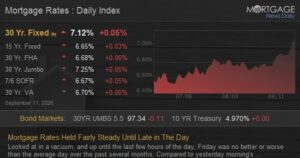
Mortgage Rates Held Fairly Steady Until Late in The Day

Looked at in a vacuum, and up until the last few hours of the day, Friday was no better or worse than the average day over the past several months. Compared to yesterday morning’s levels, the average lender was 0.01% higher–a small enough move to be effectively considered “unchanged.”  This expanded to 0.05% in the last few hours as multiple lenders increased rates. In terms of big-picture benchmarks, the increase officially brings rates to their highest levels since early 2025. To be clear, we were just barely lower than May 2025 levels yesterday. Now we’re in line February 2025 levels. The intraday market movement was interesting. The bond market (which underlies mortgage rate movement) actually improved this morning even though Fed rate hike expectations increased following a slightly hotter inflation reading in this morning’s economic data. This is an uncommon pattern. There are two ways to look at it. First, longer-term rates may have been encouraged by the uptick in Fed rate hike expectations because that provided reassurance that Fed was more likely to take steps to combat higher inflation. In other words, some of the upward pressure in longer-term rates is thought to have been driven by fear of Fed inaction. If this morning’s inflation data was hot enough to increase the odds of action, but not so hot as to cause a material change in the inflation outlook, it’s the perfectly warm bowl of porridge. In OTHER other words, yes! There’s a scenario where longer-term rates (things like mortgages and 5-10yr Treasury yields) actually WANT the shortest-term rates (like the Fed Funds Rate) to move higher.

Read More »
By using our site, you agree to use our cookies. For more information, read our Privacy Policy