VA Home Loans in Franklin, TN: Benefits, Eligibility, and $0-Down Options
An eligible Franklin buyer may use a VA-backed loan to purchase a qualifying primary residence with no down payment when entitlement is sufficient and the sales price does not exceed the appraised value. The borrower must still meet VA and lender credit, income, occupancy, asset, and property requirements.
Buying in Franklin can require a different plan from buying in a lower-price Tennessee market. Home price, property taxes, homeowners insurance, HOA dues, appraisal support, and cash reserves all shape the decision. For an eligible Veteran, service member, or surviving spouse, a VA-backed purchase loan can reduce one of the largest barriers: the down payment.
The best-known benefit is the possibility of financing a home with $0 down. Other advantages can be equally valuable, including no monthly private mortgage insurance, competitive loan terms, flexible underwriting, and limits on certain borrower-paid costs. Yet a VA loan is not automatic financing. Eligibility must be documented, the borrower must qualify, the home must be an eligible primary residence, and the property must support the price and meet applicable requirements.
This guide explains how VA home loans work in Franklin, what “zero down” really means, how entitlement and the funding fee affect the transaction, and how to prepare a strong offer without overlooking cash-to-close or property risks.
What is a VA home loan?
A VA home loan is usually made by an approved private lender and partially guaranteed by the U.S. Department of Veterans Affairs. The guaranty reduces lender risk and helps support benefits such as zero-down financing and no monthly mortgage insurance. The VA does not set the interest rate on a standard VA-backed loan; lenders establish rates, points, fees, and approval standards within VA requirements.
The modern program traces back to the Servicemen’s Readjustment Act of 1944, commonly called the original GI Bill. Its purpose was to expand access to homeownership for those who served. That history still matters: the VA guaranty is an earned benefit, not a grant, and the borrower remains responsible for repaying the mortgage.
The official VA-backed purchase-loan overview lists potential benefits including no down payment when the sales price is not above appraised value, no PMI or FHA-style MIP, fewer closing costs, and no penalty fee for paying the loan off early.
The most important VA loan benefits for Franklin buyers
$0 down when the transaction supports it
An eligible buyer with sufficient entitlement may finance up to the lower of the purchase price or appraised value, subject to lender approval. That can preserve savings for moving, repairs, furnishings, emergencies, or post-closing reserves. Zero down is an option, not an instruction to spend every available dollar.
No monthly PMI or MIP
VA loans do not require monthly private mortgage insurance or FHA mortgage insurance premiums. Homeowners insurance, property taxes, and HOA dues still apply. Removing monthly mortgage insurance can improve a payment comparison, especially when the alternative conventional down payment is below 20%.
Flexible, whole-file underwriting
The VA does not publish a universal minimum credit score. Lenders can establish their own score requirements and other overlays. Underwriting considers credit history, stable income, debts, housing payment, residual income, assets, and compensating factors rather than treating one number as the entire decision.
Reusable entitlement
The benefit is not limited to one lifetime use. Entitlement may be restored after a prior VA loan is paid off and the property is sold, and some borrowers can hold more than one VA loan when they have sufficient remaining entitlement and satisfy occupancy and qualification rules. The Certificate of Eligibility must be reviewed for the actual calculation.
Funding-fee exemptions for some borrowers
Many VA borrowers pay a one-time funding fee, but qualifying recipients of service-connected disability compensation, certain surviving spouses receiving Dependency and Indemnity Compensation, eligible pre-discharge claimants, and qualifying active-duty Purple Heart recipients may be exempt. The lender verifies status through the COE and requires documentation.
Who is eligible for a VA loan in Franklin, TN?
Potential eligibility extends to qualifying Veterans, active-duty service members, National Guard members, Reserve members, and certain surviving spouses. Service requirements depend on when and how the person served, whether the service was active duty or qualifying Guard/Reserve service, and the character or reason for discharge.
For example, the official VA home-loan eligibility guide states that a current service member generally meets the minimum active-duty requirement after at least 90 continuous days. Veteran requirements vary by service period. National Guard and Reserve pathways can include qualifying active-duty service or six creditable years under specified conditions. Exceptions may apply for a service-connected disability or other qualifying discharge reason.
The Certificate of Eligibility is the starting document
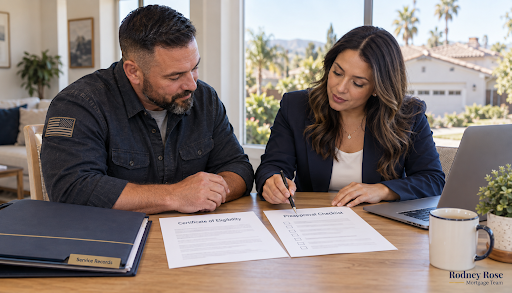
A Certificate of Eligibility, or COE, confirms that the applicant meets the service-based eligibility rules and shows entitlement information. A lender can often request it electronically, or the borrower can request it through VA.gov. Common supporting records can include a DD214 for a Veteran, a statement of service for an active-duty member, points statements and discharge documents for Guard or Reserve service, or VA forms for an eligible surviving spouse.
A COE does not approve the mortgage. It answers the benefit question; underwriting answers whether the borrower, property, and transaction qualify. Request the COE early because prior VA loans, an unrestored entitlement, service-record questions, or funding-fee status can change the structure.
Primary-residence occupancy is required
VA purchase financing is generally for a home the borrower intends to occupy as a primary residence. A spouse may satisfy occupancy in some active-duty circumstances, and deployment or retirement timing can require special documentation. A second home, vacation property, or pure rental property needs a different loan unless a permitted owner-occupancy situation applies.
How $0-down VA financing really works
Three inputs should be checked before advertising a purchase as zero down: entitlement, appraised value, and lender approval.
Full entitlement versus remaining entitlement
The official VA entitlement and loan-limit guidance explains that a borrower with full entitlement does not have a VA-imposed loan limit, provided the borrower qualifies and the appraisal supports the transaction. This does not mean unlimited borrowing. The lender still evaluates income, debts, assets, credit, and its maximum loan size.
When entitlement is already tied to another VA loan or was not fully restored after a prior transaction, county conforming limits can affect the guaranty calculation. A borrower with insufficient remaining entitlement may need a down payment to reach the required guaranty. That is why a repeat user should complete an entitlement worksheet before choosing a maximum Franklin price.
Entitlement Position | What It Generally Means | Recommended Planning Action |
Full entitlement | No VA-imposed loan limit; lender qualification and the VA appraisal still control | Verify the lender’s loan-size, income, credit, asset, and reserve requirements |
Remaining entitlement | Part of the borrower’s entitlement remains tied to a prior VA loan, so county loan limits affect the guaranty calculation | Calculate the remaining guaranty and any potential down payment before shopping |
Restorable entitlement | Prior loan and property history may allow previously used entitlement to be restored | Request entitlement restoration and obtain an updated Certificate of Eligibility |
The appraisal can create a cash requirement
Assume a buyer agrees to pay $650,000, but the VA Notice of Value supports $630,000. The VA-backed base loan is generally limited by the lower supported value. The parties may renegotiate, the buyer may use a contractual appraisal protection, the value may be reconsidered with appropriate market evidence, or the buyer may choose to cover some difference with cash. Zero-down eligibility does not make an unsupported appraisal gap disappear.
Zero down is not always zero cash to close
Even with no down payment, buyers may need funds for earnest money, inspection, appraisal, prepaid interest, homeowners insurance, tax and insurance escrows, title-related charges, recording, and other closing expenses. Seller or lender credits and permitted gifts can reduce the buyer’s cash, but they must be structured within program and contract rules.
Cash Item | Possible Treatment | Why You Should Plan Early |
Down payment | May be $0 with sufficient entitlement and a supported appraisal value | Remaining entitlement or an appraisal gap may create a down-payment requirement |
VA funding fee | May be financed or paid at closing; waived for eligible exempt borrowers | Financing increases the loan balance and total interest paid |
Other closing costs | Generally paid at closing and may be offset by permitted credits | These costs generally cannot be added to the base VA purchase-loan amount |
Prepaids and escrows | Usually collected for property taxes, homeowners insurance, and prepaid interest | The amount changes with the closing date and property-specific expenses |
Inspection and appraisal | Often paid before or during the transaction | These expenses may still be owed even if the purchase does not close |
Use the closing-cost calculator for a first estimate, then replace every assumption with the Loan Estimate, contract credits, title figures, insurance quote, and verified tax information.
Credit, income, DTI, and residual-income requirements
Eligibility is not the same as loan approval. The lender must document that the proposed payment is sustainable.
Credit history and lender overlays
Because VA itself does not set a single minimum score, a borrower should not assume every lender uses the same threshold. The review can include payment history, housing history, collections, judgments, federal debt, bankruptcy or foreclosure history, recent inquiries, and new obligations. A stronger score can improve pricing, but clean explanations and re-established history may matter when the file is not perfect.
Stable and reliable income
Income can include eligible military pay and allowances, civilian employment, retirement, disability benefits, or other documented sources expected to continue. Variable, overtime, bonus, commission, self-employment, rental, and recently changed income require the applicable history and analysis. Tax-free income may receive permitted adjustment in qualification, but the lender applies the rules.
DTI and residual income answer different questions
Debt-to-income ratio compares applicable monthly debts with qualifying income. Residual income estimates what remains after taxes, debts, the proposed housing payment, and certain obligations. VA underwriting uses residual income as a practical household-cash-flow measure, with the applicable benchmark affected by region, household size, and loan amount. A file with a higher DTI may need stronger residual income or other compensating factors; a low DTI does not cure unstable income.
Payment comfort should be stricter than maximum approval
Franklin buyers should evaluate principal, interest, city and county taxes when applicable, homeowners insurance, HOA dues, maintenance, utilities, and commuting or lifestyle costs. Test the full payment with the mortgage payment calculator and the housing affordability calculator. Calculator outputs are estimates, not underwriting decisions.
A household still weighing timing and flexibility can use the rent-versus-buy calculator to compare an estimated ownership period with continued renting.
VA funding fees, closing costs, and seller contributions
The VA funding-fee and closing-cost guide lists the current purchase rates, effective April 7, 2023. The fee is calculated from the loan amount, not the purchase price.
VA Purchase-Loan Use | Down Payment | Current Funding Fee |
First use | Less than 5% | 2.15% |
First use | 5% or more | 1.50% |
First use | 10% or more | 1.25% |
Subsequent use | Less than 5% | 3.30% |
Subsequent use | 5% or more | 1.50% |
Subsequent use | 10% or more | 1.25% |
Funding-fee rules can change, and exemptions override the table when properly verified. If the fee is financed, it raises the starting balance. Compare a voluntary down payment only after considering liquidity, monthly payment, rate, fee reduction, emergency reserves, and other goals.
Closing-cost credits and seller concessions are not identical
The buyer and seller can negotiate payment of many ordinary closing costs. VA states that it does not cap credits for the loan’s closing costs, but seller concessions, items of value such as paying the funding fee, paying certain debts, or prepaying hazard insurance, are generally limited to 4% of the home’s reasonable value. The contract and disclosure should identify each item accurately rather than calling every seller-paid dollar a concession.
Use the current mortgage-rates page for broad market context. A real comparison should show rate, APR, discount points, lender credit, temporary or permanent buydown, funding fee, cash to close, and the break-even period.
VA appraisal, property requirements, and inspection
A VA appraisal supports reasonable value and reviews whether the home appears to meet VA minimum property requirements for safety, sanitation, and structural soundness. The lender receives a Notice of Value that can include required repairs or conditions. The appraisal is not designed to find every defect and is not a substitute for a home inspection.
Property Review | Primary Purpose | Buyer Takeaway |
VA appraisal | Determines the property’s value and checks observable compliance with VA property requirements | Protect the appraisal contingency and prepare for possible repair conditions |
Home inspection | Provides a detailed evaluation of the home’s systems, condition, and maintenance risks | Hire an independent, qualified inspector and carefully review the findings |
Specialized inspection | Evaluates specific concerns involving the roof, sewer, foundation, HVAC, septic system, or pests | Order one when the property’s age, disclosures, or general inspection findings justify further evaluation |
Tennessee is among the states where VA requires wood-destroying-insect information before the Notice of Value is issued. Confirm the current form, inspection scope, responsible party, timing, and any treatment or repair conditions with the lender and contract professionals.
Eligible properties can include single-family homes, qualifying manufactured homes, homes with up to four units, and units in VA-approved condominium projects. For a two-to-four-unit property, the Veteran generally must occupy a unit, and projected rental income receives lender analysis. A condo’s VA approval status should be checked before the offer; HOA budget, insurance, litigation, assessments, and rental restrictions can still affect approval.
Franklin and Williamson County considerations
Franklin offers historic homes, newer subdivisions, condominiums, townhomes, and properties near Cool Springs and the Nashville employment corridor. Those choices can produce very different underwriting and ownership costs even at the same price.
Verify property taxes instead of copying a listing estimate
A Franklin address may involve Williamson County taxes and, when the property is inside applicable city boundaries, city taxes. Confirm the parcel, assessed value, exemptions, current bills, and the lender’s escrow estimate. A tax figure copied from a listing or prior owner may not reflect the buyer’s future bill.
Tennessee operates property-tax relief for qualifying disabled Veteran homeowners and certain surviving spouses. The Tennessee Comptroller’s explains that this relief is a state reimbursement, not an automatic exemption, and that applications go through the county trustee or city collecting official. Eligibility and benefit amounts must be verified separately from VA loan approval.
Obtain insurance and HOA information early
Get a property-specific homeowners insurance quote before relying on a payment. For an HOA property, review current dues, master coverage, reserves, litigation, pending assessments, rental rules, and any transfer or capitalization fees. These costs affect both qualification and the household budget.
Make the VA offer easy to understand
A strong Franklin VA offer can include a fully reviewed preapproval, verified COE and entitlement, documented funds for closing or an appraisal gap if applicable, realistic financing and appraisal timelines, and a lender who can explain VA requirements to the listing side. Avoid promising that no repairs will ever be required; explain that the home must support value and meet applicable property standards.
Local assistance is available through the team’s Franklin office information. Begin the underwriting conversation before touring at the top of a price range.
VA loans compared with other Franklin mortgage options
Loan Option | Down-Payment Profile | Mortgage-Insurance Profile | Potential Fit | Key Caution |
VA loan | Potentially $0 with sufficient entitlement and a supported appraisal value | No monthly PMI or MIP; a VA funding fee may apply | Eligible buyer purchasing a primary residence | Occupancy, entitlement, appraisal, and lender approval still control |
Conventional loan | Low-down-payment options may be available | PMI commonly applies with less than 20% equity | Buyer with a strong standard credit and income profile | PMI, pricing, credit, and reserve requirements vary |
FHA loan | Low down payment under applicable FHA requirements | Upfront and annual mortgage insurance generally apply | Buyer who may benefit from FHA’s qualification framework | Mortgage insurance and property requirements affect the overall cost |
USDA loan | Potentially $0 down | Upfront and annual guarantee fees generally apply | Income-eligible buyer purchasing in an eligible area | Property-location and household-income limits apply |
Jumbo loan | Required down payment varies by lender and program | Product-specific requirements | Higher-priced purchase supported by a strong financial profile | Liquidity, appraisal, credit, and reserve requirements may be stricter |
Review
conventional loans, FHA loans, USDA loans, Jumbo loans against the same property and holding period. Some buyers should also ask whether a down payment assistance program can work with an eligible first mortgage; compatibility is program-specific.
Common VA loan mistakes to avoid
1. Treating the COE as loan approval
The COE verifies benefit eligibility and entitlement. Credit, income, assets, debts, occupancy, property, appraisal, title, and insurance remain subject to review.
2. Assuming zero down means zero money needed
Closing costs, prepaids, inspections, appraisal, earnest money, reserves, or an appraisal gap may require cash even when the down payment is zero.
3. Ignoring prior entitlement use
An existing VA loan, assumption, foreclosure, or prior loan not restored can change the guaranty and down-payment calculation.
4. Using an online value as the appraisal result
The VA appraiser develops an independent supported value. Protect the transaction with appropriate contract advice and do not spend an appraisal-gap reserve twice.
5. Skipping the home inspection
Minimum property requirements are not a complete condition report. Inspect the roof, structure, electrical, plumbing, HVAC, drainage, pests, and other material systems.
6. Checking condo approval after contract
A project approval issue can disrupt financing. Confirm the VA status and review the HOA before committing.
7. Opening credit or moving money without a plan
New debts can change qualification, while unexplained transfers can delay asset verification. Keep a clear paper trail and consult the lender before major financial changes.
8. Comparing only the interest rate
Compare APR, points, lender credits, funding fee, monthly payment, cash to close, reserves, and break-even period. The lowest displayed rate is not automatically the least expensive structure.
Expert preparation tips
- Request the COE first. Verify eligibility, entitlement, prior-loan history, and funding-fee status before setting a price ceiling.
- Build two budgets. Keep the lender’s qualifying payment separate from a personal budget that includes maintenance, utilities, commuting, and savings.
- Run an appraisal-gap scenario. Decide how much cash, if any, can be used if the value is below the contract price.
- Price insurance and HOA dues before offering. Property-specific costs can move DTI and residual income.
- Keep reserves after closing. Zero down can preserve cash; it should not justify buying without an emergency cushion.
- Use a VA-aware team. The lender, real estate professional, inspector, title/closing team, and insurance agent should understand the timeline and documentation.
- Compare structures. A VA loan can be excellent without being automatically cheapest in every case. Use a purchase qualification review for a side-by-side analysis.
For definitions of COE, entitlement, DTI, residual income, APR, escrow, appraisal, and points, visit the mortgage glossary. The mortgage FAQ provides additional general education.
Fictional Franklin VA loan examples
Important: These examples are simplified and fictional. They do not represent available rates, property values, tax bills, approvals, or commitments to lend.
First-use Veteran with full entitlement
Alex has full entitlement, stable civilian income, and funds for closing but prefers to preserve savings. The contract price and VA appraised value are both $575,000. Subject to final underwriting, a zero-down structure may be possible. Alex compares financing the 2.15% funding fee with paying it at closing and keeps a separate emergency reserve.
Repeat user with remaining entitlement
Morgan still owns a prior home with a VA loan after relocating. The new Franklin purchase is not automatically zero down. The lender reviews the COE, entitlement already charged, applicable county limit, occupancy reason, both housing obligations, and remaining guaranty. Morgan receives the calculation before making an offer and adjusts the price range and cash plan.
Disabled Veteran with an exemption
Taylor’s COE reflects an eligible funding-fee exemption. Removing the fee reduces the upfront or financed cost, but it does not waive title charges, prepaids, taxes, insurance, inspection, or appraisal. After closing on a primary residence, Taylor separately contacts the local collecting official about Tennessee disabled-Veteran property-tax relief rather than assuming it was built into underwriting.
Duplex buyer using owner occupancy
Jordan wants a Franklin-area duplex and plans to occupy one unit. The lender evaluates the property’s eligibility, appraisal, condition, lease or market-rent evidence, reserves, management experience when applicable, and how much rental income can be used. The loan is not treated as a pure investment-property mortgage because genuine primary-residence occupancy remains required.
A practical Franklin VA loan process
Step 1: Verify eligibility and entitlement
Obtain the COE, review prior VA use, and confirm funding-fee status.
Step 2: Complete financial preapproval
Document income, assets, debts, credit, housing history, residual income, and cash-to-close sources through the loan qualification process.
Step 3: Set the property and offer strategy
Estimate taxes, insurance, HOA dues, closing costs, and appraisal-gap capacity. Confirm condo or multi-unit considerations before offering.
Step 4: Contract, appraisal, and inspections
Complete independent inspections, allow the lender to order the VA appraisal, address Notice of Value conditions, and finalize title and insurance.
Step 5: Final underwriting and closing
Satisfy conditions, avoid new debt, verify final funds, review the Closing Disclosure, and confirm that the payment and cash due match the approved plan.
Frequently asked questions
Can I buy a Franklin home with no down payment using a VA loan?
Potentially. You need sufficient entitlement, lender approval, an eligible primary residence, and a sales price supported by the VA appraisal. Remaining entitlement or an appraisal gap can create a down-payment requirement.
What credit score is required for a VA loan?
VA does not set one universal minimum credit score, but lenders may impose their own requirements. Approval also depends on credit history, income, debts, residual income, assets, property, and other risk factors.
What is a Certificate of Eligibility?
A COE is the VA document showing service-based home-loan eligibility and entitlement information. It may also reflect funding-fee status. It does not replace lender underwriting or guarantee approval.
Do VA loans have a maximum loan amount?
Borrowers with full entitlement do not have a VA-imposed loan limit, but the lender’s qualification and loan-size rules and the property value still apply. Borrowers with remaining entitlement are affected by county-limit guaranty calculations.
How much is the VA funding fee?
For a purchase with less than 5% down, the current fee is 2.15% for first use and 3.30% after first use, unless exempt. Fees are lower at down payments of at least 5% or 10% and can change.
Can the seller pay my VA closing costs?
The seller may pay negotiated ordinary closing costs, and VA separately limits seller concessions to 4% of reasonable value. Contract credits must be acceptable to the lender and cannot exceed actual eligible costs.
Is the VA appraisal the same as a home inspection?
No. The appraisal addresses supported value and observable VA property requirements. A home inspection evaluates condition and maintenance risks in greater detail. Buyers should normally consider both.
Can I use a VA loan for a condo in Franklin?
Yes, when the unit and project meet VA and lender requirements. Confirm VA project approval, HOA finances, master insurance, litigation, assessments, and property conditions before relying on the financing.
Can I buy a duplex with a VA loan?
Potentially. VA purchase loans can finance homes with up to four units when requirements are met and the Veteran occupies a unit. Rental-income and reserve treatment depend on documentation and underwriting.
Can I use a VA loan more than once?
Yes. Entitlement may be restored after a prior VA loan is paid and the property is sold, and some borrowers can use remaining entitlement while another VA loan exists. The COE and guaranty calculation control.
Are disabled Veterans automatically exempt from Tennessee property taxes?
No. Tennessee’s program provides relief to qualifying disabled Veteran homeowners and certain surviving spouses, but it is not an automatic exemption. A separate application and eligibility review are required.
How long does a Franklin VA loan take to close?
Timing depends on preapproval quality, contract dates, appraisal availability, property conditions, title, insurance, and underwriting. A verified COE, complete documents, realistic deadlines, and early inspections reduce avoidable delays.
Conclusion: use the benefit with a complete purchase plan
A VA home loan can provide exceptional buying power in Franklin: potentially zero down, no monthly PMI, reusable entitlement, flexible underwriting, and funding-fee exemptions for some borrowers. Those advantages work best when the buyer also understands cash to close, entitlement, residual income, property requirements, appraisal risk, and local ownership costs.
Start with the COE and a complete financial review. Then estimate the full payment, verify taxes and insurance, inspect the property, check condo or HOA issues, and protect a post-closing reserve. The goal is not merely to qualify, it is to close on a home with a payment and cash plan that remains comfortable after moving day.
Ready to review your Franklin VA loan options?
Meet Rodney Rose and request a side-by-side review of VA, conventional, FHA, USDA, or jumbo financing for your Franklin purchase. Your COE, entitlement, credit, income, property, appraisal, and final lender guidelines determine the available options.

Written by Rodney Rose
NMLS #1396861
Rodney Rose is a California mortgage professional dedicated to helping families navigate home financing with confidence. Through clear guidance on mortgage programs, loan options, and down payment assistance, Rodney Rose helps homebuyers make informed decisions and move closer to achieving their homeownership goals.