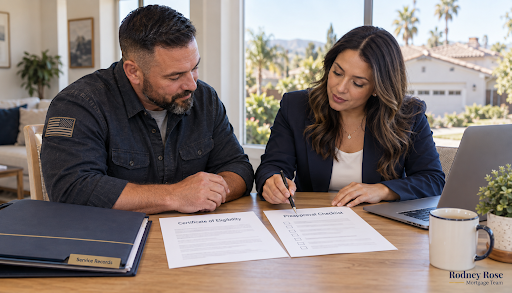
VA $0-Down Loans in California: Cash to Close and Preapproval
California Veterans, service members, and eligible surviving spouses often hear “VA loans offer $0 down” and assume little cash will be needed. A VA-backed purchase loan can remove the down-payment barrier, but it does not erase closing costs, prepaid taxes and insurance, an appraisal shortfall, or property-specific expenses. This article explains what zero down covers and what a useful preapproval should verify before you make an offer.
For service requirements, COE details, refinance options, and the complete program, use the site’s VA home-loan program overview.
Quick Answer: An eligible borrower with sufficient entitlement may be able to buy a California primary residence with no down payment when the lender approves the loan and the price does not exceed VA’s appraised reasonable value. Cash may still be needed for closing costs, prepaids, inspections, an appraisal gap, or a down payment required by a remaining-entitlement calculation.
When $0 Down Is Actually Available
The VA-backed purchase-loan rules allow no-down-payment financing when the sales price is not above the appraised value, subject to a valid Certificate of Eligibility (COE), qualifying occupancy, and both VA and lender approval. A COE confirms service-related eligibility and entitlement; it is not a loan approval.
With full entitlement, VA does not impose a county loan limit. The lender still decides how much the borrower can qualify for, and the loan generally cannot exceed the lower of the price or appraised value. With remaining entitlement, the lender uses the COE and the property’s county conforming limit to calculate the available guaranty. The official VA entitlement and loan-limit guidance explains why that calculation can create a down-payment need.
Transaction | Likely cash effect | Decision before an offer |
Full entitlement; price at or below value | $0 down may be available | Verify lender approval, occupancy, property eligibility, and non-down-payment cash. |
Remaining entitlement | A down payment may be required | Complete the county-specific guaranty calculation first. |
Price above reasonable value | Buyer may face an appraisal gap | Set a renegotiation, cash, or contract-exit plan. |
Voluntary 5% or 10% down | Lower balance and possibly a lower funding-fee tier | Compare fee savings with reduced liquidity and reserves. |
California Appraisal-Gap Example
Assume a buyer agrees to pay $900,000 and the VA Notice of Value is $875,000. The $25,000 unsupported difference is not financed merely because the buyer has full entitlement. The buyer may renegotiate, support a reconsideration of value, bring allowable cash, or use applicable contract rights. Preapproval should reserve cash for this possibility.
What Zero Down Does Not Cover
VA purchase loans do not require monthly PMI. Many non-exempt borrowers instead pay a one-time funding fee. The current VA funding-fee and closing-cost chart lists a 2.15% purchase fee for first use and 3.30% after first use when the down payment is less than 5%. The fee can be financed or paid at closing; qualifying disability, survivor, pre-discharge, or Purple Heart status can create an exemption.
Educational $850,000 Funding-Fee Example
$850,000 purchase, $0 down | Rate | Fee | Starting loan if financed |
Funding-fee exempt | 0% | $0 | $850,000 |
First use, under 5% down | 2.15% | $18,275 | $868,275 |
Subsequent use, under 5% down | 3.30% | $28,050 | $878,050 |
Educational example only. It assumes the base loan equals the purchase price, sufficient entitlement, a supported appraisal, and lender approval. Funding-fee rates shown are effective April 7, 2023 and were rechecked September 9, 2026; confirm the current rate and exemption before closing.
Only the funding fee can be financed into a VA purchase loan. Other fees and charges are paid at closing, although permitted seller or lender credits may offset some costs. Plan for the appraisal, inspection, title and settlement charges, prepaid interest, the initial tax and insurance escrow, and any discount points. Start with the site’s closing-cost calculator, then replace estimates with transaction figures.
VA does not cap credits applied to eligible ordinary closing costs, but defined seller concessions are limited to 4% of reasonable value. Credits cannot exceed eligible costs, and lender, contract, disclosure, and interested-party rules still apply. The CFPB Loan Estimate explainer shows where to check the loan amount, projected payment, closing-cost total, lender credits, rate-lock status, and estimated cash to close.
California Costs That Can Change the Approval
Do not copy the seller’s current property-tax bill into your budget. Under the California Board of Equalization’s change-in-ownership guidance, a typical home purchase is reassessed to current fair market value, which can produce a different annual bill and a supplemental assessment.
Obtain a property-specific homeowners-insurance quote early, especially where wildfire, flood, or other hazard exposure affects cost or availability. Add HOA dues and special assessments to the housing payment. For a condominium, confirm VA project eligibility and review the association’s master insurance before relying on the approval amount.
Use the mortgage payment calculator with the base loan plus any financed funding fee. Then compare that payment with the household’s own limit using the California affordability guide. The lender’s maximum is not automatically a comfortable budget.
Five Preapproval Steps Before a California Offer
Verify eligibility and entitlement. Obtain a current COE and identify prior VA use, remaining entitlement, and funding-fee status.
Document the borrower. Provide income, employment, credit, debts, assets, housing history, and any records needed for residual-income analysis.
Set two limits. Separate the lender’s maximum approval from a household price and payment ceiling that preserves cash reserves.
Update for the address. Insert actual taxes, insurance, HOA obligations, property type, appraisal risk, and any condominium conditions.
Audit the Loan Estimate. Confirm the base loan, financed funding fee, credits, projected payment, cash to close, rate-lock status, and unresolved conditions.
Repeat the review if the rate, price, address, income, debts, insurance quote, appraisal, or available funds change. A preapproval letter reflects a preliminary lender review; it is not a commitment to lend or a guarantee of closing.
Frequently Asked Questions
Can a seller pay a VA buyer’s closing costs?
Yes, eligible closing costs may be negotiated with the seller. VA treats ordinary closing-cost credits differently from seller concessions, which are capped at 4% of reasonable value. Actual costs, the contract, and lender rules limit how much credit can be used.
Does a funding-fee exemption eliminate all cash needs?
No. An exemption removes the VA funding fee, not appraisal, inspection, title, tax, insurance, escrow, discount-point, or appraisal-gap costs. The final cash requirement depends on the property, closing date, credits, deposits already paid, and loan structure.
Can a California buyer choose to put money down?
Yes. A voluntary down payment lowers the base loan and may move a non-exempt purchase into a lower funding-fee tier at 5% or 10% down. Compare the payment and fee reduction with the value of keeping liquid reserves after closing.
What if the VA appraisal is below the contract price?
The base loan is generally limited by the lower supported value. The buyer may renegotiate, present appropriate market evidence for reconsideration, bring allowable cash, or use applicable contract rights. Review the contract with the relevant real estate or legal professional.
What Should a California VA Buyer Do Next?
A VA loan can remove the down payment and monthly PMI, but the practical decision is whether the complete payment and cash-to-close plan remain sound after entitlement, the funding fee, appraisal risk, taxes, insurance, HOA obligations, and reserves are included. Before committing to a price, request a VA purchase qualification review that shows the base loan, any financed funding fee, all-in payment, expected cash to close, and the conditions that could change the result.
Consumer Disclosure: This article is educational and is not a commitment to lend, loan approval, legal or tax advice, or a guarantee of eligibility, entitlement, property acceptance, appraisal value, rates, terms, or closing. VA, lender, investor, property, insurance, and underwriting requirements apply and may change. Equal Housing Opportunity.

Written by Rodney Rose
NMLS #1396861
Rodney Rose is a California mortgage professional dedicated to helping families navigate home financing with confidence. Through clear guidance on mortgage programs, loan options, and down payment assistance, Rodney Rose helps homebuyers make informed decisions and move closer to achieving their homeownership goals.