







Upstate New York bucking national housing slowdown
Planned tech development is expected to bring even more buyers to upper New York

Planned tech development is expected to bring even more buyers to upper New York


These last-minute moving day reminders will help you keep all the details organized when moving to a new home.
The post 8 Last-Minute Moving Day Reminders for a Stress-Free Move appeared first on Redfin | Real Estate Tips for Home Buying, Selling & More.
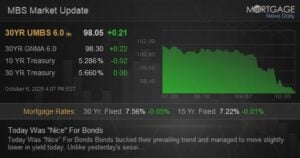
Today Was “Nice” For Bonds
Bonds bucked their prevailing trend and managed to move slightly lower in yield today. Unlike yesterday’s session which had no clear correlation with underlying events, today’s move traced a drop in oil prices fairly clearly. Some analysts thought that an improvement in French government bonds may have been mildly encouraging as well, but that would require drawing the opposite conclusions from last week’s narrative about French bond turmoil benefiting the U.S. as a safer haven. In any event, the rally was too small to merit that much thought. Yields encountered resistance at 5.26%, but could also be broadly finding buying support when yields crest 5.3%. Bottom line, today was “nice,” but in and of itself, not enough to suggest a meaningful shift in momentum.
Market Movement Recap
02:57 PM Near best levels. MBS up over a quarter point and 10yr down 3.8bps at 5.269

Mortgage rates actually fell today–something they’ve done only 7 times since August 25th. While the outright levels remain near the highest since 2003, they’re near the lowest in just over a week with top-tier 30yr fixed rates down to 7.56% for the average lender. What gives? Is this a sign that recent upward momentum is starting to wane? It’s too soon to conclude such things, but it is somewhat encouraging that yesterday’s long-term high was basically right in line with the high seen on September 30th (7.61 vs 7.60). This is the sort of “double top” behavior that some analysts look for when trying to identify momentum shifts. Bottom line: it’s too soon to start celebrating. But it’s better than the average day of late. [thirtyyearmortgagerates]

Lender will obtain both FICO and VantageScore on every credit pull

Move comes as Rocket’s servicing book tops $2 trillion and 9.1 million loans

I like to say that I am one good Lottery Scratcher away from ditching this daily Commentary gig and starting something new. All kidding aside, where should we start today? With the rumored FICO layoffs yesterday afternoon? Iowa, Michigan, and the Carolinas all having conferences now? Pennymac is now live with VantageScore 4.0 across all three production channels. If you want to learn about appraisal news, there’s a 7AM PT (you’re your read that right) Fannie webinar tomorrow morning: Fannie Mae’s UAD 3.6 Policy Exception: What You Need to Know! Two Harbors and UWM are firing shots at each other. In terms of interest rates, oil price inflation from the war, the U.S. budget deficit, competition for investor money from AI companies issuing debt, and tariff price inflation aren’t going away any time soon, so there is little reason for rates to drop. Lenders and vendors are wondering if they want to go through another business cycle, and on today’s Advisory Angle at 11AM PT, STRATMOR’s Amanda Gibson and Garth Graham discuss what mortgage lending leaders should be thinking about now, before a leadership transition becomes urgent. Tech of varying shapes and sizes is the focus of Mortgage Matters tomorrow at 11AM PT (presented by Lenders One and featuring Blue Sages’s Ash Omar) and The AI Show at noon PT (presented by JazzX AI and featuring JazzX AI’s Kunal Patel). (Today’s podcast can be found here. This week’s ‘casts are presented by Floify, the mortgage industry’s leading point-of-sale platform. Dynamic Apps, which can be seen at booth 600 during MBA Annual next week, lets lenders create fully customizable loan applications for any loan type, including HELOCs, construction, agricultural lending, non-QM and more, without custom development. Today’s has an interview with Polly’s Adam Carmel on where capital markets tech is heading: AI-native foundation, unified operating system, and the first firm built to run on it. Introducing PollyOS/Hedge.)

If rate movement were a car, it’s been driving pretty recklessly recently, and definitely not keeping good pace with other motorists. But every now and then, we see a break in the craziness. The overnight trading session provided an example. The bond car set its adaptive cruise control to follow the car in front of it (oil prices, in today’s case). That’s left us just a bit stronger to start, but it’s not an inspiring reversal so much as a coincidental mini-correction. 10yr yields unfortunately seem to be hitting resistance at 5.26%, but oil bounced at the same time, and we’re not really in love with technicals these days. This afternoon’s 3yr Treasury auction has a small chance of being mildly interesting (emphasis on small/mild).

There has been a lot of interest in how tariffs affect consumer prices (for example, Cavallo et al. 2021, 2025). In this post, we present results from our new research paper that estimates the effects of the 2025-26 tariffs on retail consumer prices. We find that for every percentage point increase in average tariffs, consumer goods prices increase by about a quarter of a percent after one year. Roughly two-thirds of the effect arises because tariffs raise the prices of imported consumer goods. The remaining third arises indirectly: tariffs increase the prices of goods made in the U.S. because producers pay more for imported parts and materials, and because producers raise their markups when competing imports cost more. The effects differ in their timing. Prices of imported goods respond quickly to tariffs, while prices of U.S.-made goods adjust over six to twelve months as higher costs move through the supply chain.