






Hands stacking coins to illustrate saving, budgeting, or building financial growth

Mortgage Rate Intelligence & Market Updates

Stay informed about economic developments that may influence mortgage rates and home financing decisions. Explore updates covering inflation, Federal Reserve policy, Treasury yields, housing trends, and other important market indicators. Use the category filters to browse relevant economic and mortgage news, then select an article to read the full update. Review the latest stories and market insights to better understand changing conditions when considering your mortgage options.
RATE WATCH
FED FUNDS RATE 3.88%
NEXT FOMC 10/28/2026
NEXT MOVE 29.6% HIKE
IMPLIED CHANGE +7.4 bps
12-MONTH OUTLOOK +77.7 bps 3-4 HIKES
TARGET BAND 3.75 - 4.00%
SOFR 3.88%
LATEST FED UPDATE 10/9/2026

What Today’s Economic Data Can Mean for Mortgage Rates

Mortgage rates can respond to changes in inflation, employment, Federal Reserve policy, Treasury yields, and expectations about future economic growth. These factors do not determine mortgage rates by themselves, but they can influence the broader bond market and the pricing lenders offer.

For homebuyers and homeowners, the important question is not simply whether economic news is “good” or “bad.” The key is how new information changes expectations for inflation, interest rates, and the economy. Those changes can contribute to mortgage rate movement and affect purchasing power, refinance opportunities, and monthly payment estimates.

Use the market updates below as supporting information, then consider your specific loan type, credit profile, property, and financing goals when evaluating current mortgage options.

Economic News Hub

Real Estate & Financial Market Updates

Article
People lined up outside a bank entrance in a grand city building

Reading the Panic: How Investors Perceived Bank Risk During the 2023 Bank Run

Natalia Fischl-Lanzoni, Martin Hiti, and Asani Sarkar The bank run that started in March 2023 in the U.S. occurred at an unusually rapid pace, suggesting that depositors were surprised by…
The Financial Stability Implications of Tokenized Investment Funds

The Financial Stability Implications of Tokenized Investment Funds

Pablo Azar, Francesca Carapella, JP Perez-Sangimino, Nathan Swem, and Alexandros P. Vardoulakis In a previous post, we provided background information about the emergence of tokenized investment funds and their use…
The Emergence of Tokenized Investment Funds and Their Use Cases

The Emergence of Tokenized Investment Funds and Their Use Cases

Pablo Azar, Francesca Carapella, JP Perez-Sangimino, Nathan Swem, and Alexandros P. Vardoulakis A blockchain is a distributed database where independent computers across the world maintain identical copies of a transaction record, updating…
Financial Intermediaries and Pressures on International Capital Flows

Financial Intermediaries and Pressures on International Capital Flows

Linda S. Goldberg and Samantha Hirschhorn Global factors, like monetary policy rates from advanced economies and risk conditions, drive fluctuations in volumes of international capital flows and put pressure on…
Rodney Rose Mortgage Team
Loans available nationwide
Low Rate, Low Fee.
"A Loan for every home"
Guaranteed Closing*
Rodney Rose, Loan Officer and Branch Manager
Rodney Rose
Loan Officer / Branch Manager
NMLS#: 1396861 DRE#: 00853403
C: (916) 232 3040
E: rrose@emortgagecapital.com
W: MortgageMarketUpdate.com
Better Business Bureau accreditation badge on a white background
Offices
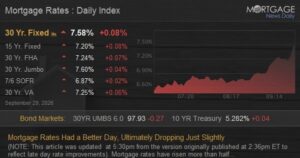
Mortgage rates daily index showing 30-year fixed rate at 7.58%

Mortgage Rates Had a Better Day, Ultimately Dropping Just Slightly

(NOTE: This article was updated  at 5:30pm from the version originally published at 2:36pm ET to reflect late day rate improvements). Mortgage rates have risen more than half a point in 2 weeks. While that’s certainly not the fastest jump we’ve seen, it is an extraordinarily uncommon pace–happening less than once per year on average (i.e. it only happened 3 times between 2010 and 2019). Today’s initial increase was modest in the bigger picture, adding only 0.04% to yesterday’s levels and leaving the average top-tier 30yr fixed rate still just a hair below 7.50%. This is roughly in line with the highs from early 2024 and still well below the highs of 8% seen in October 2023. Much of that initial 0.04% increase can be thought of as a hangover from yesterday’s volatility. In fact, the underlying bond market had already improved day-over-day at the time we marked the 0.04% increase. Thankfully, additional gains in the afternoon led lenders to drop rates back below yesterday’s latest levels. The final mark was 7.43% for the average lender. [thirtyyearmortgagerates] Whether this friendly bounce means anything about the road ahead is a different matter. If traders knew what the road ahead looked like with any certainty, they wouldn’t sit on their hands and lose money between now and then. In other words, anything that you or I can conclude about the near-term future is already priced-in to current levels. The next leg higher or lower for rates will likely be determined by a combination of economic data that hasn’t come out yet and war-related headlines that could either help or hurt the fuel price outlook. Next week is a big week for econ data and every week brings new potential for oil price fluctuations these days. In addition, the month/quarter end trading environment increases the risk of volatility regardless of directional cues from data/events.

Read More »
New York Stock Exchange trading floor with closing bell display and market screens

Treasury Trading at the Close

In past work, we showed that trading in U.S. Treasury securities is becoming increasingly concentrated on the last trading day of each month. In this post, we show that trading is also becoming more concentrated around the designated pricing, or “strike,” times for fixed-income indexes. The concentration is especially pronounced on month-end trading days. We also document a marked shift in trading activity from around 3 p.m. (ET) to around 4 p.m. after a major fixed-income index provider moved its strike time from 3 p.m. to 4 p.m. in January 2021.

Read More »
Financial market chart with fluctuating lines and candlestick price movements

The New York Fed DSGE Model Forecast—September 2026

This post presents an update of the economic forecasts generated by the Federal Reserve Bank of New York’s dynamic stochastic general equilibrium (DSGE) model. We describe very briefly our forecast and its change since June 2026. The New York Fed DSGE model expects similar growth, and slightly more persistent inflation, compared to its forecasts in June. r* forecasts are slightly lower for 2026 but higher for the remainder of the forecast horizon.

Read More »
By using our site, you agree to use our cookies. For more information, read our Privacy Policy