









Hands stacking coins to illustrate saving, budgeting, or building financial growth

Mortgage Rate Intelligence & Market Updates

Stay informed about economic developments that may influence mortgage rates and home financing decisions. Explore updates covering inflation, Federal Reserve policy, Treasury yields, housing trends, and other important market indicators. Use the category filters to browse relevant economic and mortgage news, then select an article to read the full update. Review the latest stories and market insights to better understand changing conditions when considering your mortgage options.
RATE WATCH
FED FUNDS RATE 3.88%
NEXT FOMC 10/28/2026
NEXT MOVE 28.4% HIKE
IMPLIED CHANGE +7.1 bps
12-MONTH OUTLOOK +81.7 bps 3 or 4 hikes
TARGET BAND 3.75 - 4.00%
SOFR 3.87%
LATEST FED UPDATE 10/5/2026

What Today’s Economic Data Can Mean for Mortgage Rates

Mortgage rates can respond to changes in inflation, employment, Federal Reserve policy, Treasury yields, and expectations about future economic growth. These factors do not determine mortgage rates by themselves, but they can influence the broader bond market and the pricing lenders offer.

For homebuyers and homeowners, the important question is not simply whether economic news is “good” or “bad.” The key is how new information changes expectations for inflation, interest rates, and the economy. Those changes can contribute to mortgage rate movement and affect purchasing power, refinance opportunities, and monthly payment estimates.

Use the market updates below as supporting information, then consider your specific loan type, credit profile, property, and financing goals when evaluating current mortgage options.

Economic News Hub

Real Estate & Financial Market Updates

Article
Ugly Snowball Selling Thanks to Oil and Inflation Data

Ugly Snowball Selling Thanks to Oil and Inflation Data

Ugly Snowball Selling Thanks to Oil and Inflation Data MBS lost nearly a full point by 4pm ET and 10yr yields were up 11.4bps at 4.95%. This is the highest…
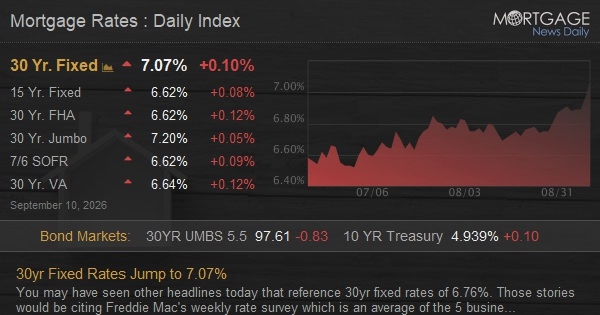
30yr Fixed Rates Jump to 7.07%

30yr Fixed Rates Jump to 7.07%

You may have seen other headlines today that reference 30yr fixed rates of 6.76%. Those stories would be citing Freddie Mac's weekly rate survey which is an average of the…
Financing, Settlement, Processing Tools; Credit Score Tumult; Treasury Buybacks

Financing, Settlement, Processing Tools; Credit Score Tumult; Treasury Buybacks

Here in San Antonio, TX, interest rates are obviously part of mortgage event discussion. (On today’s The Big Picture Guild’s David Battany will be discussing rates and recent developments impacting…
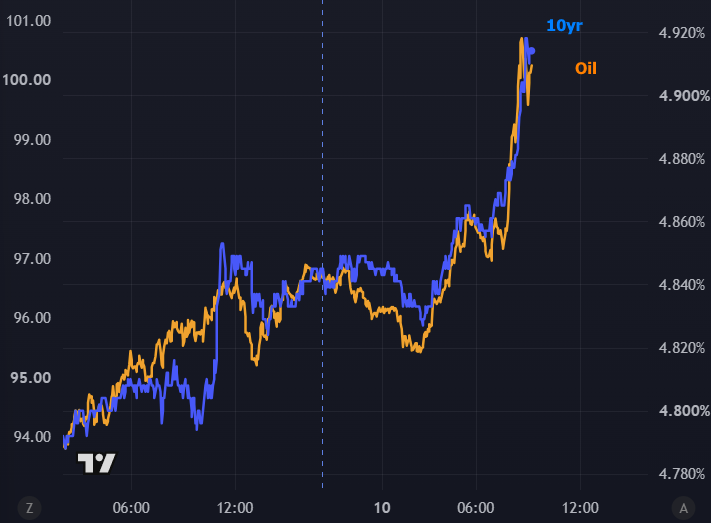
Chart comparing rising 10-year Treasury yield with oil prices over time

Sharply Weaker Again. Half Oil. Half PPI

It's been a rough couple of days for the bond market. Yesterday, it was Bessent and the reaction to the Treasury buyback announcement. Today it is an overnight surge in…
Real estate professional showing a bright apartment to a smiling couple during a property tour

What Renters Are Looking for in 2026

The modern rental market has shifted from shiny, surface-level perks to grounded, functional living. Today’s renters care less about flashy rooftop lounges and more about practical layouts, genuine value, and…
The Ultimate Final Walk-Through Checklist Before Closing on a Home

The Ultimate Final Walk-Through Checklist Before Closing on a Home

You’ve nearly completed the entire homebuying process. From those early days of using a mortgage calculator to see how much house you could afford, to touring homes online or in-person,…
Suffolk County, MA Housing Market Update: August 2026

Suffolk County, MA Housing Market Update: August 2026

Key Takeaways Suffolk County home prices jumped 7.3% year over year to $857,131 in August, driven by a surge in luxury transactions that pulled the median upward. Sales volume declined…
Plymouth County, MA Housing Market Update: August 2026

Plymouth County, MA Housing Market Update: August 2026

Key Takeaways Plymouth County home prices surged 6.5% year over year to $702,648 in August—the second-strongest gain among Greater Boston’s core counties—as the South Shore continued to attract buyers priced…
Rodney Rose Mortgage Team
Loans available nationwide
Low Rate, Low Fee.
"A Loan for every home"
Guaranteed Closing*
Rodney Rose, Loan Officer and Branch Manager
Rodney Rose
Loan Officer / Branch Manager
NMLS#: 1396861 DRE#: 00853403
C: (916) 232 3040
E: rrose@emortgagecapital.com
W: MortgageMarketUpdate.com
Better Business Bureau accreditation badge on a white background
Offices
Has Broader Stock Market Participation Changed How Interest Rates Affect the Economy?

Has Broader Stock Market Participation Changed How Interest Rates Affect the Economy?

Stock market participation in the U.S. has changed dramatically over the past four decades. In the mid-1980s, fewer than 30 percent of households held equity. By the early 2000s, more than half of U.S. households owned equity, either directly or through mutual funds, 401(k)s, and IRAs. As participation widened, the way stock market fluctuations passed through to household spending may have changed, with potential implications for how the broader economy behaves. An argument can be made that the rise in equity market participation has dampened the response of output to interest rate changes as stock market fluctuations are now spread across a larger share of households, moderating movements in consumer spending, asset prices, and investment spending.


Read More »
Does the Equity Term Structure Respond to Monetary Policy Shocks? 

Does the Equity Term Structure Respond to Monetary Policy Shocks? 

A long-standing body of research, inspired by Bernanke and Kuttner (2005), has documented the effects of Fed interest rate surprises on stock markets. While stock markets provide valuable information about the investor risk premium and dividend growth expectations, researchers have only recently developed more comprehensive tools to estimate the term structure of equity risk premia and dividend growth expectations across a broad range of maturities. In this post, we investigate the impact of monetary policy surprises (or shocks) on short- and long-term estimates of risk premia and growth expectations through the lens of the Giglio, Kelly, and Kozak (2024) model.

Read More »
How Distressed Are Consumers? Reconciling Diverging Credit Card Delinquency Measures

How Distressed Are Consumers? Reconciling Diverging Credit Card Delinquency Measures

Total debt balances declined slightly by $13 billion in the second quarter of 2026, according to the latest Quarterly Report on Household Debt and Credit from the New York Fed’s Center for Microeconomic Data. Mortgage and student loan balances saw a small decline, while there were increases across other debt products. Delinquency rates across most products remained fairly stable. Still, between 2022:Q3 and 2026:Q1, the percentage of credit card balances 90+ days delinquent rose from 7.6 percent to 12.8 percent, prompting concerns that Americans are falling behind on their debt payments at rates not seen since the Great Recession. Yet the flow delinquency rate—which captures the rate of new delinquencies—has remained relatively stable for almost two years. In this post, we use data from the New York Fed Consumer Credit Panel (CCP) to better understand the state of the consumer, and to explain the difference between our two measures of delinquency. We find that the stock delinquency rate is rising because of a pool of stale, charged-off debts that lenders have been reporting for longer durations, rather than a fundamental worsening in the incidence of delinquency.

Read More »
Stripping STRIPs Trading Activity

Stripping STRIPs Trading Activity

In March 2020, the Financial Industry Regulatory Authority (FINRA) began reporting aggregate trading volume for securities issued by the U.S. Treasury Department. The public data do not, however, include information about the trading activity of Separate Trading of Registered Interest and Principal of Securities (STRIPS). STRIPS are created from existing Treasury securities and offer risk […]

Read More »
Why Do Fewer Renters Expect to Move?

Why Do Fewer Renters Expect to Move?

Americans are moving less than they used to. Moving rates have declined steadily for decades, falling from close to 20 percent annually in the mid-1980s to below 10 percent by 2019. This decline has persisted through business cycles and has been evident across all regions, and has affected a broad range of demographic groups. Falling mobility matters because moving helps households access job opportunities, adjust to changing circumstances, and improve their housing situations. In this post, we show that the decline in mobility also holds for renters, with growing challenges to owning a home being an important contributing factor.  We use data from the annual New York Fed SCE Housing Survey to study renters’ expected mobility and the factors that shape it. Renter mobility is important as renters account for roughly a third of U.S. households and, unlike homeowners, are not subject to mortgage rate lock-in. Since expected mobility predicts actual moving behavior, it provides an early signal of where residential mobility is headed before moves occur.

Read More »
AI’s Impact on Labor and Hiring

AI’s Impact on Labor and Hiring

Welcome to Street Level, my new series on Liberty Street Economics. As research director, I try to keep track of the wide range of work that the economists at the New York Fed produce. My goal for this series is to periodically offer some thematic discussion of that work, highlighting recent analysis by Research staff and adding my own observations on the issue at hand. In this inaugural post, I’ll focus on perhaps the hottest topic going: How artificial intelligence is changing the labor market and hiring behaviors.

Read More »
A Window into Bond Investors’ Uncertainty About R‑Star

A Window into Bond Investors’ Uncertainty About R‑Star

Monetary policymakers closely monitor the term structure of sovereign bond yields to uncover market participants’ beliefs about the future monetary policy stance, inflation, and activity. A particular object of interest is the natural real rate of return, or “r-star,” which acts as a guide for monetary policy decisions. Numerous papers have questioned how much information investors possess, and how precisely they know r-star. In this post based on a recent Staff Report, we explore what the term structure of interest rates can teach us about r-star and its perception by investors.

Read More »
Stablecoins and (Non)Crypto Shocks: A 2026 Update

Stablecoins and (Non)Crypto Shocks: A 2026 Update

Stablecoins are digital assets whose value is pegged to that of a fiat currency, typically the U.S. dollar at a peg of $1.00 per token.  In a previous blog post, we described the rapid growth of stablecoins through early 2025, highlighted changes in stablecoins’ reserve-asset composition, and examined their reactions to Bitcoin price shocks. In this post, we document the growth of stablecoins since our last post. Then, we examine how shocks from outside the crypto industry can impact the composition of stablecoins’ reserve assets. For our case study, we use the 2023 failure of Silicon Valley Bank (SVB) and its impact on USD Coin (USDC, issued by Circle), the second-largest stablecoin by market capitalization.

Read More »
Nonbank Subsidiaries and the Hidden Fragility of Internal Capital Markets Reallocation

Nonbank Subsidiaries and the Hidden Fragility of Internal Capital Markets Reallocation

This post concludes a three-part series on how bank regulation interacts with the organizational structure of banking firms. The first post documented the equity-rich nonbank subsidiaries inside bank holding companies (BHCs); the second post showed that BHCs met Basel III by reallocating capital internally, moving equity from nonbank affiliates to bank subsidiaries rather than raising new external capital. Here we ask what that reallocation meant for financial stability. The series draws on the authors’ recent Staff Report, “Regulatory Arbitrage Within the Firm.”

Read More »
By using our site, you agree to use our cookies. For more information, read our Privacy Policy